`Navaratri Kolu` is a major Hindu festival, which is celebrated during `Dussehra` or `Navaratri` throughout India, especially in Southern India. This is a major festival of South India, which is celebrated for 10 days during September or October month.
 `Navaratri Kolu` festival is celebrated in a very beautiful and colourful manner in all South Indian states. During this festival, a mini-exhibition of toys and dolls are set up in many Hindu homes. The origin of this unique festival is not known clearly but it is said that it existed at least for the past five hundred years i.e. from the days of the Vijayanagar kings of Hampi in Karnataka. The reference of the festival `Navaratri Kolu` is found in the inscriptions of these kings. The Tanjavur Maharaja Sarfoji`s Saraswathi Mahal Library old Marathi record mentions that dolls representing eighteen different castes were supplied at that time. This proves its antiquity. Even the royal families of the Tanjavur and Pudukkottai kingdoms of Tamil Nadu used to celebrate the `Navaratri Kolu` festival in a very grand manner.
The most surprising fact is that the `Navaratri Kolu` festival is not confined to India only, it is also celebrated in many other Asian countries, mainly in Sri Lanka and Japan. In Japan, the `Navaratri Kolu` is known as `Hina Masturi`. During this festival they display beautiful Japanese dolls and miniature tableware in rows, exactly like the kolu in India. Whether it is in India or in any other country, `Navaratri Kolu` is mainly a ladies festival.
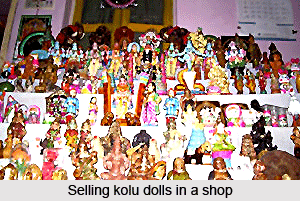 The preparation for the `Navaratri Kolu` festival starts months in advance. The `Kolubommai` or `kolu` dolls are tenderly wrapped in cotton rags, which are generally kept carefully in huge wooden trunks. So, during the preparation, the dolls are taken out with care, dusted, mended and given a fresh coat of paint if needed. Each `Navaratri Kolu` festival must have at least few new dolls. The creative housewives are given the responsibility to make new dolls every year. The new dolls replace the old worn-out ones and they are sold and purchased on the eve of the festival.
The scene of rows of tiny shops selling kolu dolls on the roadside pavements is very common during the festival. These dolls are imported mainly from the major doll making centres such as Madurai, Tanjavur and Banrutti (Panruti) in Tamil Nadu. It is high time of business for these shopkeepers when women and children come to them. Earlier, as many people used to live in joint families, the houses were big so they celebration of `Navaratri Kolu` festival used to be very grand and elaborate. A whole room was used only for this festival. The dolls were displayed on the kolupadis or kolu steps made of wood and covered with a thick cloth, milk white or blood red in colour. The number of steps had to be an odd number like three, five, seven or nine. The more the number of steps, the more is the joy.
The dolls used in the `Navaratri Kolu` festival are mostly huge mud icons of various gods and goddesses painted in bright colours. The dolls were made of rosewood, sandalwood and even by ivory in the rich families. A Ramayana set, a Dashavatara set, a set of musicians playing different instruments can be seen in almost all Kolus. The other things which can be noticed include the pot-bellied Chettiar and his equally fat wife, both smiling with their mouth wide open and in this the children often tries to feed the Chettiar by throwing grains of rice into his cave-like mouth.
 Some of the Kolus also had miniature kitchen-vessels, made of soapstone or brass. These vessels are filled with grains and pulses before keeping them in the kolu by the ladies. Many fruits made of mud or painted on wood are also kept there. The floor space on the sides of the kolupadi is decorated like villages, gardens, parks and temples. Among these the temple scene is most famous and mounds of sand are collected in cloth bags from the riverbanks to build the narrow streets surrounding the temple. If the Murugan temple is set then it is rightly placed on a small hillock and it should have a mud tank in die front. An old brass channel is placed to symbolise the tank. The temple tanks of that time should have water up to the top.
But as the time has changed, few of the rituals of the `Navaratri Kolu` festival has also changed. Families have become smaller and neutral and the western affect has influenced the Kolu festival also. The big houses have turned into two or three bedroom flats and the modern workingwomen can hardly offer much time in preparing the dolls. Those who inherited it from their mothers, grandmothers or great grandmothers have placed them in the glass boxes and decorated their living rooms with these dolls.
But, luckily, few of the South Indian families in Indian and even in foreign countries have kept this age-old traditional festival alive. Few of the corporate houses also sponsor some local clubs and associations to organise kolu competitions during the Navaratri. Attractive prizes are also kept for the best kolu dolls.
Now, the present day `Navaratri Kolu` festival is just a miniature replica of the kolus of the olden days. There are many innovations and substitution can be seen in the Kolus of present day. As the earlier wooden Kolupadi have vanished, the iron Kolupadis are used now, which are available in few selected furniture shops. These Kolupadis are used as bookshelves after the `Navaratri Kolu`. Some other creative people also make kolu steps out of big boxes and outsized dictionaries. The white and red cloth covers of the steps are replaced with plastic sheets or paper. Even the dolls of gods and goddesses are also replaced by the dolls adorned with the traditional costumes of the different states of India and the different countries of the world. Most of the NRI families use the dolls of the airhostess. Other three popular dolls include the dolls representing the postman with his kakhi uniform and mailbag, the doctor with his stethoscope and the shopkeeper with his wares.
With the coming of technology, the designer Kolus are also made during the `Navaratri Kolu` festival. Apart from the dolls, these kolus also exhibit colourful books including pop-up books and bath books, stamps, coins, medals, paintings, charts, children`s toys and games. The Kolu room is also decorated with the help of computer graphics. Even the floor decoration process has seen many new innovations like in place of the village scenes and temples; the events from the not-too-distant past are made as the theme. For example, the general elections, the Kargil war and the Olympic Games are presented through various models and figures and with the use of thermocol and cotton.
The celebration with a thematic Kolu during Navaratri is a new development regarding this festival. In this type of Kolu, the entire kolu, both on the steps and on the floor, revolves around a particular theme. During 1997, the Kolus were prepared imitating the freedom struggle to celebrate the golden jubilee of the independence of the country.
Now, in this era, an English teacher once prepared the kolu based on the scenes from Shakespearean plays. As a single woman cannot keep kolu in their homes, they join together and make a kolu with others in a common place; generally their workplace or it may be in any community hall or departmental store. These promote the team spirit and reflect the collective talent and imagination of the community.
The children enjoy this Navaratri Kolu` festival the most as it becomes like a nine-day crash course on hard work, discipline and courtesy. They work with joy and keep the kolu room clean and neat throughout the festival. They eagerly invite and welcome the guests and show them the Kolu and the models prepared by them.