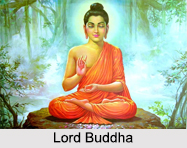
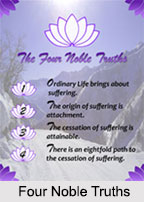
 Four Noble Truths are one of the most cardinal Buddhist teachings. In broad terms, these truths are associated with suffering"s nature, origin, cessation and the path leading to cessation. They are among the truths, Gautama Buddha is known to have realised during his experience of enlightenment. The Four Noble Truths appear numerous times throughout the most ancient Buddhist texts like the Pali Canon. Mahayana Buddhism regards these as an introductory teaching for people not ready for its own teachings.
Teachings of Lord Buddha
The Teachings of Buddha are centred on meditation, which allows an insight into the mind which helps to rejuvenate and understand things with a better perspective. This whole process to long lasting happiness is a step-by-step procedure, by following which all can transform their state of mind, which might be in trouble and confused. His teachings in way are the doorway to a blissful state of mind. Buddhism helps the mind to deviate away from fanciful thinking and takes a much uncomplicated look at everybody"s human conditions.
Four Noble Truths in Buddhism
The Four Noble Truths are an expression of his understanding of the nature of "suffering", the primal cause of all suffering, the escape from suffering, and what extent a person can go to so that they themselves can attain "happiness".
The four noble truths are as follows:
1. Nature of Suffering (Dukkha): No one on this earth is bereft of suffering. Everyone has to go through the miseries of birth, sickness, old age and finally culminating in death. Everybody arrives in this world crying, when one falls sick he/ she feels helpless, it pains more when one grows old because old age reduces energy and it is difficult to move around. Death is again painful; people are scared to die. Therefore life signifies suffering. Buddha"s teachings do not ignore the suffering that is a part of everybody"s life, just as it has happiness; it also has its own share of sadness. Happiness as well as sadness is all momentary, according to Buddha.
 2. Suffering"s Origin (Samudaya): According to Buddha"s teaching, in order to eradicate the suffering, knowledge of the origin of suffering is highly crucial. "It is this craving which leads to renewed existence, accompanied by delight and lust, seeking delight here and there, craving for sensual pleasures, craving for existence, craving for extermination".
3. Suffering"s Cessation (Nirodha): According to Buddhism, one should get rid of greed and ignorance. These are the vices that never let anyone lead a better life. A complete change in one"s outlook will come if one can do away with greed and ignorance. This can lead to a much better and peaceful life. When all suffering will end, the state of Nirvana is achieved. The Buddha said, "The extinction of desire is Nirvana". This is the ultimate state of perpetual happiness, which is really difficult unless one can sacrifice their greed, ignorance, and lustful ambitions.
4. Way leading to the Cessation of Suffering (Marga): In order to end one"s suffering, Buddhism advises to follow a Middle Path. This is known as the Noble Eightfold Path. This according to the teachings in Buddhism can be the means to end all worldly strife. Whatever unhappiness one faces in life is a result of an extreme way of life, which can be altered by following a moderate middle path. These are the basic truths in life but from which one can also move out by following the teachings of Buddhism. Cessation of sufferings arises with the elimination of inner defilements, when one can enter into the Buddhic essence with oneself.