The southern region in India is defined and acknowledged by its predominance of maritime climate and sea shores, with magnificent splendour lacing its borderlines. Being wholly based on the coasts of Indian Ocean and the Bay of Bengal, south India is that perfect combination of sea, sand and sun. Its coconut, or palm tree lined arenas, or the sudden appearance of dense forests hidden with unusual medicinal plants, or the dominance of the wild and ferocious, makes it the place that had witnessed its evolvement since prehistoric times. Indeed, south Indian temples and their fabulous architecture and the rare scriptures unearthed, even date back prior to the Indus Valley Civilization. The absolutely overwhelming Dravidian section of people that reside in the states of Andhra Pradesh, Tamil Nadu, Kerala and Karnataka, make up their secluded lifestyle that can be apprehended only perhaps by a thorough visit to south India. Besides these states, south India is also delineated by the Union Territories of Puducherry and Lakshwadeep Islands, where French is known to occupy a pride place. With such ancient eras defining its historical evolvement, it becomes obvious that the germination of South Indian languages also had occurred from the Dravidian group of civilisation. Dravidian family of languages does stand in stark contrast with its northern counterpart of Indo-Aryan languages and its evolvement.
South Indian languages comprise one of the five Dravidian languages of Kannada, Malayalam, Tamil, Telugu and Tulu. Besides, these languages also serve as official languages for the concerning states and its governmental purposes. The approximated population of South India comes to a count of 233 million. The largest linguistic groups in South India encompass the Telugus, Tamils, Kannadigas, Malayalis, Tuluvas, Kodavas and Konkanis, which, quite manifestly mirrors the diversification and overlapping of language cultures and customs. According to the 2001 Census, Telugu possessed the third largest base of native speakers in India (74 million), after Hindi and Bengali. Telugu as such, was awarded the status of classical language in 2008. Tamil was granted the status of classical language by the Government of India in 2002 and had approximately 60 million native speakers. Kannada possessed 38 million, whereas Malayalam had 33 million native speakers respectively. Each of these south Indian languages is enlisted as an official language of India, as per the Official Languages Act (1963).

Tamil
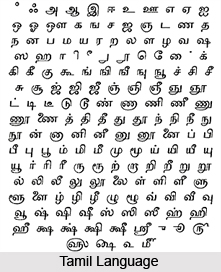
Tamil, one of the two classical languages of India, is the only language of contemporary India which is recognizably continuous with a classical past. It is the official language in the south Indian state of Tamil Nadu and the Union Territory of Pondicherry. In the 1991 Census of India, Tamil speakers in Tamil Nadu alone numbered around 56 million: Substantial numbers of Tamil speakers can also be found in Sri Lanka and Malaysia and significant minorities in Singapore, Fiji and Mauritius. There are around 71 million speakers worldwide.
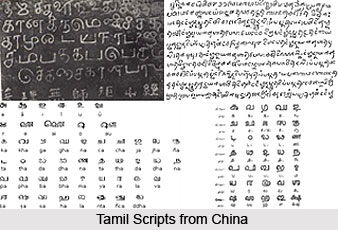
The Tamil alphabet is descended from the Brahmi script of ancient India. The earliest Tamil inscription dates back to at least 500 BC. The oldest literary text in Tamil, Tolk?ppiyam, was composed around 200 BC. During the 19th century, attempts were made to create a written version of the colloquial spoken language. Nowadays the colloquial written language appears mainly in school books and in passages of dialogue in fiction.

Tamil is classed as a Dravidian language, and is one of the major Dravidian languages of South India. The exact origins of the Dravidian family are unknown but it is believed to have arrived in India`s northwest around 4000 BC, gradually splitting into four branches with the passage of time. Tamil became isolated to India`s South as the Indo-Aryan language varieties such as the Hindi became more dominant in the North.
Along with Sanskrit, Tamil is recogonised as `one of the two classical languages if India`. It has a rich historical tradition dating back more than 2000 years. Modern Tamil is diglossic in nature, which means it has two distinct forms: literary or classical (used mainly in writing and formal speech) and spoken (used in everyday conversation).
Kannada
Kannada also known as kanarese is also a Dravidian language. It is the official language of the state of Karnataka in india`s south-west, where it`s spoken by around 35 million people. After Telugu and Tamil it`s the third most spoken Dravidian language of South India.
The earliest known example of Kannada literature is the Kavirajamarga, which dates back to the 9th century AD, and today the modern language is represented by a thriving tradition covering all literary genres.

Malayalam
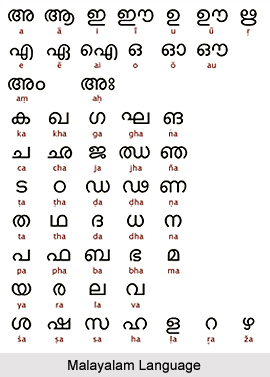
Like Tamil, Malayalam belongs to the Dravidian language family. Though there are obvious lexical links between the two languages, with many words sharing common roots, Malayalam however includes a far greater number of borrowings from ancient Indian Sanskrit. Its divergence from tamil began sometimes after the 10th century AD, with the first official literary record of it dating back to the Ramacharitam, a pattu poem written in the 12th century.
The modern form of the Malayalam script developed from the 16th century literary works of Tunchatt Ezhutacchan. It is the official language in the state of Kerala on India`s far south-western coast, where it`s spoken by around 30 million people.
Telugu
Telugu is a south-east Dravidian language spoken mainly in the state of Andhra Pradesh on India`s east coast: it became the state`s official language in the mid-1960s with around 70 million speakers. It is the most predominant of South India`s four major Dravidian languages. Its literary history dates back to the 11th century AD when the poet Nannaya produced a translation of parts of the Mahabharata. While Sanskrit has played a major role in Telugu literature over the centuries, there is an increasing tendency for written works to reflect the more colloquial variety of modern standard Telugu.