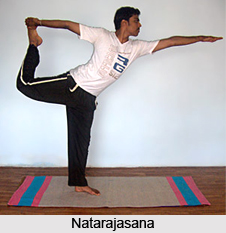
 Natarajasana is a cultural asana derived from Nataraja, the god of Dance. It stretches the body muscles, especially those of the back, the limbs and shouldes and chest.
Meaning of Natarajasana
The root word "Nata" refers to actor and dancer, Raja means "the king." Natraj is another name for Shiva, who is also known as the cosmic dancer. His dance symbolizes cosmic energy in its "five actions:" creation, maintenance, and destruction or re-absorption of the world, concealment of authentic being, and grace.
Practice of Natarajasana
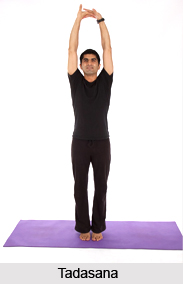
* Stand in Tadasana. Inhale, shift the weight onto the right foot, and lift the left heel toward the left buttock while bending the knee.
* Press the head of the right thigh bone back, deep into the hip joint, and pull the knee cap up to keep the standing leg straight and strong.
* Try to keep the torso relatively upright. The first is to reach back with the left hand and grasp the outside of the left foot or ankle. To avoid compression in the lower back, actively lift the pubis toward the navel, and at the same time, press the tailbone toward the floor.
* Begin to lift the left foot up, away from the floor, and back, away from the torso.
* Extend the left thigh behind the body and parallel to the floor.
* Stretch the right arm forward, in front of the torso, parallel to the floor.
* The second option with the hands is to sweep the right hand around behind the back and catch hold of the inner left foot.
* Sweep the left hand back and grab the outside of the left foot. This variation will challenge the balance even more.
* Raise the thigh as described above. This second variation will increase the lift of the chest and the stretch of the shoulders.
* Stay in the pose for 20 to 30 seconds. Then release the grasp on the foot, place the left foot back onto the floor, and repeat for the same length of time on the other side.
For the full pose, perform first two steps as described above.
* Turn the left arm actively outward (so the palm faces away from the side of the torso), bend the elbow, and grip the outside of the left foot. (One can also grab the big toe with the first two fingers and the thumb.)
* The fingers will cross the top of the foot, the thumb will press against the sole.
* Inhale, lift the left leg up, and bring the thigh parallel to the floor.
* While doing this, rotate the left shoulder in such a way that the bent elbow swings around and up, so that it points toward the ceiling. It requires extreme flexibility to externally rotate and flex the shoulder joint in this way.
* Reach the right arm straight forward, in front of the torso and parallel to the floor.
* Hold for 20 to 30 seconds, release, and repeat on the second side for the same length of time.
Anatomical stress points will be groins, thighs, chest, lungs, shoulders and spine. Many beginners, when lifting the leg, tend to cramp in the back of the thigh. Be sure to keep the ankle of the raised foot flexed; that is, draw the top of the foot toward the shin.
Effects of Natarajasana
* Stretches the shoulders and chest
* Stretches the thighs, groins, and abdomen
* Strengthens the legs and ankles
* Improves balance
Precautions in the practice of Natarajasana:
Natarajasana is not recommended in the cases of High or low blood pressure, serious lower-back injury and knee injury.