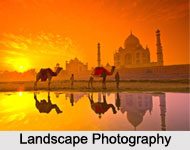
 Landscape photography demonstrates places in the world, sometimes huge and continuous. Landscape photographs normally capture the charisma of nature which can also focus on man-made features or disorders of landscapes. Landscape, nature and wildlife photography done as an occupation, art, or simply as a hobby, it tends to create indeed a large hole in a person`s pocket. Large amounts of money are spent on equipment, film processing and travel.
The term "Urban Landscape" describes photographs of the city taken in the manner of a landscape, using buildings and other man-made features as graphical elements of composition which are treated in the same way the photographer would treat mountains and trees. Typically, people and animals are not shown in a landscape, unless they are relatively small in the image and have been included in the composition to show scale.
Objectives of Landscape Photography in India
The objective is to evoke an individual observation or knowledge while in the outdoors, particularly when travelling. It has an outdoor lifestyle which involves the nature and its elements. Landscape photographs generally demonstrate little human activity and are created in the hunt of a pure, unsullied representation of nature.
Themes of Landscape Photography in India
Landscape photography usually involves daytime photography of natural characteristics of land, sky and waters, at a space. Some landscape photographs involve subjects in a beautiful setting close by, still close-up and sometimes at night.
Styles of Landscape Photography in India
Nowadays, one can take long night-time exposures and immediately explore and take note of the variables, such as colour shifts and of course the proper exposure needed. Apart from the way the photos are shot, it is also very important to concentrate on the way, a shot is taken. There are hence, three styles of landscape photography that are recognized and these are as follows:
Representational Style: This style is also known as the straight or straight descriptive style. It results in pictures which show scenery at its most natural and realistic state, with no visual manipulation or artifice. It is a straightforward style. Although the photographer adds no props or other components to a scene and does not try to "bend" reality, great attention is paid to composition and detail; hence the famous images seen are taken keeping the element of light, timing and the weather in mind.
Impressionistic Style: This style employs photographic techniques that result in images that have vague or elusive qualities. They are less tangible and more unreal, while still retaining their values that make them landscape pictures. The viewer is given the impression of a landscape rather than the clear reality of one.
Abstract Style: Also known as the graphic style, as the photographer treats the components of scenery as graphic elements, arranged for their compositional values. Natural elements may be rendered as unrecognizable and the shape and form take priority in this style. Elements may be juxtaposition for comparison or contrast, isolated by extreme close-up, reduced to silhouettes by severe underexposure. Design is more important than recognizable representation.
Ways of Landscape Photography in India
Firstly the understanding to see the light and look for interesting colour combinations - light, shadow and texture is necessary. The best light is normally morning light (warmer yellow), later afternoon or evening light (warmer, a hint of red to full-red). Mid-day light can make shadows and bright contrast that are difficult for the film to handle.
In India, due to high level of dust, smoke and water vapour in the atmosphere, beautiful light is seen rarely; hence, the rainy season is the best option. Secondly, one needs to travel extensively, because the weather can be quite arbitrary. The best time to click photo is only during the certain times of the year, so it best to be ready every time, and capture the idyllic landscape to the fullest.
Photographers of India
Some of the renowned Indian Photographers are Homai Vyarawalla, Raghubir Singh, Ashok Salian, Lala Deen Dayal, Raghu Rai, Vikram Bawa, Victor George, Gautam Rajyadhyaksha, Jatin Kampani, Sharad Haksar, Rathika Ramasamy, Swapan Mukherjee, Varun Aditya etc.