 Homeopathy is the youngest medical faculty. Unlike other medicines, homeopathic medicines usually do not have any side effects. The reason for this is that homeopathic medicines act by stimulating the body`s own defence mechanism and healing powers. They do not have any chemical action, so they do not have the potential to cause any sustained damage. The doses are given in sub-physiological quantities. So they can be given to children and adults alike without worrying about the dosage. Homeopathy medicine is safe for everyone.
It is modern not only by its virtue of being young, but more significantly by the revolutionary medical philosophy that supports this science. The faculty is surmounting some of the orthodox concepts and out dated practices. Homeopathy is turning more scientific, more authentic, more user friendly and more effective. The evolving trend within the domain of the classical homoeopathy is more easily accessible for practitioners the world over.
The term `homeopathy` is derived from the Greek words "homeo", meaning similar, and `pathos`, meaning suffering or disease. Homeopathy is a gentle, holistic system of healing, suitable for everyone, young and old. It primarily concentrates on you as an individual, concentrating on treating your specific physical and emotional symptoms, to provide long lasting benefits.
The therapy is founded on the theory of treating "like with like". Homeopathy serves an alternative medical system. Alternative medical systems are built upon complete systems of theory and practice as against the conventional medical approach. It takes a different approach from conventional medicine in diagnosing, classifying, and treating medical problems.
Features of Homeopathy
* It seeks to stimulate the body`s defence mechanisms and processes so as to prevent or treat illness.
* Treatment involves giving very small doses of substances called `remedies` that, according to homeopathy, would produce the same or similar symptoms of illness in healthy people if they were given in larger doses.
* The diagnosis and treatment in homeopathy is tailored to each patient according to the sickness. Homeopathic practitioners select remedies according to a total picture of the patient.
Ancestry of homeopathy
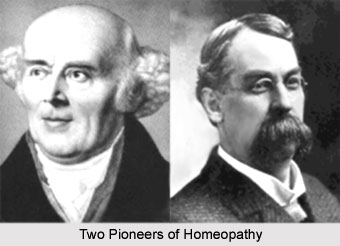
The principle of Homeopathy has been known since the time of Hippocrates- an ancient Greek Physician and the founder of medicine, around 450 BC. It is based on "the Law of Similars". The term "Similia Similibus Curanteur", meaning, `let likes be treated by likes`. A thousand years later, the Swiss alchemist Paracelsus employed a similar system of healing based upon the principle that says, "Like cures Like". But it was not until the late 18th century that Homeopathy as it is practiced today was germinated by the great German physician, Dr. Samuel Hahnemann. He was alarmed by the medical practitioners then, and set out to develop a method of healing which would be safe, gentle, and effective. He believed that human beings have a capacity for healing themselves and that the symptoms of disease reflect the individual`s struggle to overcome his illness. Over 200 years ago, Dr. Samuel Hahnemann propounded the principle that, what substance could cause in the way of symptoms, it could also cure. He was appalled by the effect that, certain drugs, when consumed by quite a healthy individual, produced symptoms that the drug was known to cure in sick. Hahnemann continued to experiment, noting that, every substance in taken, whether an herb, a mineral, an animal product or chemical compound, produced decisive distinct symptoms in the individual. He further noted that, no two substances produced exactly the same set of symptoms. Eventually, Hahnemann began to treat the sick, on the principle, "likes can be treated by likes".
Dr. James Tyler Kent (1849 - 1916) was an American physician and a significant contributor to homeopathic medicine. His work came after Samuel Hahnemann and he proved many new remedies, which were not reckoned by Hahnemann. He is well- known for his Homeopathic Philosophy and for his book "Lectures on Materia Medica", and "Repertory" known as "Kent repertory", on virtually all modern practice of which homeopathy is based.
Homeopathy
Homeopathy is a gentle, holistic system of healing, suitable for everyone, young and old.