 Paithani sarees are a part of cultural heritage of Maharashtra. It originated in the little town called Paithan in Aurangabad. These sarees are made of three kinds of silk namely, ciddle-gatta silk, china silk and charka silk, using the weaving and dyeing technique. Paithani saris are weaved on ancient tapestry looms which are operated manually. These sarees are enriched with zari (golden and silver threads), which gives it ornamental sheen and value. They are completely hand woven and extreme labor is a prerequisite to their creation. The time period required to complete one such saree ranges from 1 month to 2 years depending on the complexity and the length of the design. The real paithani saris are hand woven with real silver or gold and pure silk, so it being one of the expensive sarees in India, is not subject to amazement.
History of Paithani Sarees
Creation of paithani sarees is an age old art. Therefore, these sarees are of great antiquity. The art of creating paithani sarees dates back to 200 B.C, during the Satvahana era. Since then it is passed on from generation to generation. As it was generally created by womenfolk, the daughters would be blessed with the skill of creating these sarees. It was held in high esteem by the western travellers who used to pay for it in gold and gems. It is believed that the Nizam of Hyderabad was also attracted to the Paithani and made several trips to the small town of Paithani. His daughter-in-law, Niloufer, is believed to have introduced new motifs to the border and pallav (outer end of the saree) designs.
Weaving of Paithani Sarees
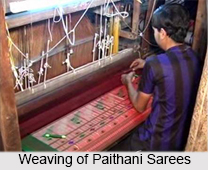
The paithani saree is an entirely hand woven item. Before weaving the saree the raw silk which is obtained from Bengaluru is cleaned with caustic soda. Then it is dyed into the different colours required. A particular colour is used for weaving lengthwise while another is used width wise. The silk threads are then separated by women and then they are ready to be woven. The whole family is involved in the weaving of this saree.
 Features of Paithani Sarees
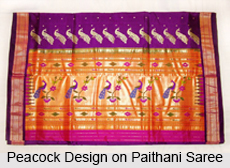
Paithani sarees have typical features. Most paithani sarees are made from silk and gold fabrics, some in cotton too. Length-wise and breadth-wise weaves create kaleidoscopic effects on these sarees. This effect is achieved by varying the weave. They have oblique square designed borders and peacock designed pallus. Famous motifs on paithani sarees are the Gautam Buddha, the Hans, the Ashraffi, the Asawall, the Bangadi Mor, the Tota-Maina, the Humarparinda, the Amar Vell and the Narali motif to name a few. Pallus of these sarees are embellished with motifs such as the Muniya, the Panja, the Barwa, the Laher, the Muthada or the Asawali. Weaves on the paithani sarees in ekdhoti or kad styles with narali borders and paisa buttis or wattana too are quite trendy during the weddings. Some paithani saree designs have certain weaves to add more touch of royalty to them, for example the kadiyal borders or the interlocked styles. Such paithani sarees are a bit more expensive than other paithani sarees. Spotted and plain designs are worn by senior-age ladies.
Types of Paithani Sarees
Paithani sarees are classified according to motifs, weaving, and colors.
Under motifs come Bangadi Mor, Munia Brocade and Lotus Brocade. The word bangadi means bangle and mor means peacock. So bangadi mor means a peacock in a bangle or in a bangle shape. The pallus are embellished with the design of the peacock. Due to this design these sarees are very expensive. Munia means parrot. Parrots are woven on the pallus as well as on the borders. Parrots are always in leaf green colour. The parrots in silk are also called tota-mania. Lotus brocade highlights that the pallus are embellished with lotus. The lotus motif consists of 7 to 8 colors.
Under weaving comes kadiyal border sari and kad or ekdhoti. Kadiyal means interlocking. The warp and the weft of the border are of the same color while the body has different colors for warp and weft. For weaving the weft of the kad or ekdhoti a single shuttle is used. The colours of the warp yarn are different from that of the weft yarn. It has a narali border and simple buttis like paisa and watana. Kad is also a form of lungi and is used by male Maharashtrians.
Different colours characterize different paithani sarees. Kalichandrakala is a pure black sari with red border. Parrot green coloured paithani sari is called Raghu. Pure white paithni sari is called Shirodak.
Maintenance of Paithani Sarees
Dry cleaning of paithani sarees is essential. It is also recommended to keep it away from scorching sunrays which might damage its silk threads. Tough washing should be avoided as the gold zari may get damaged.
This saree is generally used for festive clothing. Gifting paithani saris in a girl"s wedding trousseau is customary in the region of Maharashtra. This fabric today has stepped out of Maharashtra and has gained popularity among the people in India, United States, United Kingdom and Australia.
Related Articles:
Indian Silk Sarees
Maharashtra
Indian Costumes
Silk
Indian Clothing
Paithan