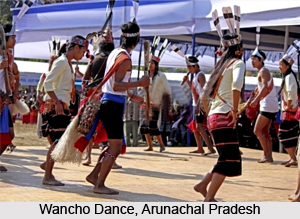
 The Wancho tribes of Arunachal Pradesh perform their special dances on the occasions like festivals, ceremonies, which are popularly known as Wancho dances. Ozele festival of the Wancho tribe is celebrated in the month of February-March, when the season of sowing the millets is over. The festival is celebrated for four days and was observed in Longkhau village. At this time, the Wancho dance is performed from about 9 p.m. to 11 p.m. inside the house of chief authority.
For the performance, the male-folk, boys, youths and adults take part while among the women, only girls and the young married women who have not joined the husband`s family can take part. Such kind of differentiation is seen in many tribal dances of India. The dancers become ready for performance with elaborate adornment, especially with fine clothing and accessories. All stand in a circle surrounding a bonfire. The girls are standing on one of side of the circle holding each other`s hands. Holding a sword in the right hand of the male dancers, most of them place their left hand on the shoulder of the left side dancer. The male dancers start singing as they start performing various steps. Firstly, they all take a short step with the right foot towards the right side and flex the knees along the forward swing of the sword. For the next time, they gently bring the left foot up to the heel of the right one. This sequence of movements is repeated several times as the course of dance.
Generally, on the eighth or ninth step of the performance the singing of the male-dancers ends. At this moment, all dancers stamp their right foot twice on the ground. The female dancers take part in the singing through which they give a reply to the men. The women stamp their right foot twice on the ground during their turn of singing, once generally on the fourth step and the next at the end of the singing, which falls on the ninth step. Again the male dancers take up the singing and thus, the dance continues further.
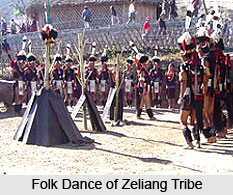
A cane basket hangs on the waist over the buttocks of the male dancers. This basket is decorated with coloured straw tassels, monkey skulls or wild animals tooth. The straw tassels of the baskets are decorated with the help of coloured beads. The straps of some of the baskets are decorated with white conch-shell discs. Apart from this, each basket has a bell that is fitted at its bottom. The tinkling of so many bells at a time gives the musical sound; hence no any other musical instrument is used for the dance. The anklets of straw and girdles having one or two loops of red cane or of bands of cowries or beads are tied just below the knee of every performer. The boys and a few youths are naked but the others wear a loincloth, either in white or light blue in colour. Two red stripes towards the end are decorated with small beads of different colours.
The armlets are either of ivory, brass or red cane loops. The handle of the sword is decorated with the help of coloured goat`s hair. All the performers wear bead necklaces and some of them also wear necklaces of coins. The ear decorations are done with tufts of red woolen threads. Some even have the headdress that is made up of bamboo, and decorated with hornbill feathers or with wild boar`s tushes. The hairs of this tribal are cut in order to have a specific shape. The hair up to the middle of the crown is brought forward and cut so that the fringe reaches just up to the top of the forehead, while the hair of the back is kept long. These are tucked in a round to a red or yellow coloured rectangular piece of wood, called the Kahpak. Some of this kahpak`s are studded with small pieces of glass while some are decorated with carvings of the human figure or human skull or with a tuft of coloured goat`s hair. Both sides of the head are always shaven.