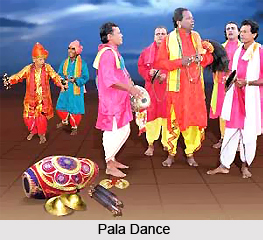
 Pala is a unique form of balladry in Odisha (formerly known as Orissa), which artistically combines elements of theatre, classical Odissi music, highly refined Oriya and Sanskrit poetry, wit, and humour. The literal meaning of pala is turn. It is more sophisticated than the other Oriya ballad tradition, Daskathia.
History of Pala Dance
The origin of Pala dates back to the Mughal periods where there were efforts to bring harmony between the Hindus and Muslims. The Pala troupes worshipped `Satyapir` - Satyanarayan of the Hindus and Pir of the Muslims thus, it lead to peaceful coexistence of both the religions in the Odisha. Though, the form originated in Bengal but it flourished better in Odisha state of India.
Performance of Pala Dance
Pala is presented in three ways. The names can be mentioned as baithaki or `seated`, in which the performers sit on the ground throughout. The other one is thia or `standing`. This is more popular and aesthetically more satisfying, in which they stand. Badi is a kind of thia in which two groups vie for excellence. This is the most entertaining, as there is an element of competition.
Usually, there are six to seven performers in a group, which cannot present Pala traditionally with fewer than four members. The gana, also known as gayaka (main singer) sings the lead, the bana or `drummer` plays the mridangam drums, and the palias or `Pala-player` are two to five associate singers, of whom the leader is called sri-palia and who strike large cymbals called kartal. The palia`s role is, more or less, like that of a chorus. They sing the refrain together with the gana and echo the last few words of other sung lines. The sri-palia is of great importance as he frequently interacts with the gana and punctuates the show with comedy. A loud percussion ensemble comprising mridanga and cymbals precedes the singing, to let the prospective audience know that the Pala is starting soon and to serve as aesthetic prelude or purvaranga.
In rural areas, the performance begins after 8:30 in the evening. At the end of the prelude, the gana enters the arena, usually level ground spread with a large cotton carpet. He begins with an invocation eulogizing the presiding deity, Satyapir, worshipped by both Hindus and Muslims. This can be traced back to the Mughal period when there were conscious efforts to bring about amity between the two faiths. After the invocation, the proper presentation commences.
Pala Poems and Songs
In Pala and in Daskathia, the gana structures the ballad himself, but the style differs. The major portion of Pala ballads comprises stanzas of ornate Oriya poetry written by eminent poets from the seventeenth to mid-twentieth centuries. These poems and kavyas that is long narrative verses were meant not only to be read but also sung in the traditional Chhanda classical form. While composing a particular ballad, the gana follows the same pattern as of classical Oriya kavya, which narrates the birth of the hero and heroine. After this, different cantos depict their growing up through infancy, adolescence, and youth. They meet and fall in love. Finally they marry. One or more cantos describe the beauty of the hero and, specially, the heroine at each stage of growing up. The picture of the youthful heroine`s beauty from head to toe occurs in great detail with wonderful similes.
Pala has the same structure. The gana does not himself compose the descriptions of the aspects of beauty but takes them directly from kavyas. For instance, if the Pala compiler wants to relate the beauty of the young heroine`s eyes, he can extract different relevant stanzas from kavyas written in Oriya or Sanskrit and attribute them all to his heroine. Thus, borrowing from various poets, the account of the heroine`s beautiful eyes may go on for hours. The gana not only sings these stanzas in appropriate Chhanda style, but also translates the meaning of the highly difficult lines in simple language. Thus, Pala popularizes sophisticated poetry among common people. If the gana is not talented enough to structure a ballad, he may requisition the services of a suitable literary person to compile it for him. But he must have an extraordinary memory to remember the countless stanzas and a high degree of literary sensibility so that he can properly explain the meaning as well as poetic merit to listeners. The gana who agrees to participate in a badi Pala has indeed a phenomenal memory and ready wit, because the other gana may challenge him on any aspect of the story.
Role of Gana
The gana is also an excellent actor with multifaceted talents. While singing or explicating he brings in drama to heighten the appeal. He then uses his chamara or fly whisk to suggest different properties. At one time, it indicates the god Indra`s thunderbolt, at another, it may delineate the lyrical movement of waves or the contour of a graceful creeper. The gana usually wears a costume similar to the formal dress of erstwhile royal nobility. The others in the group wear clothes not so splendid.
To be a good gana, one has to devote years of study and practice. It is a full-time job. The last great ganas were Harinath and Niranjan, in popular demand till the early 1950s. The demand decreased, but they held sporadic Palas till the mid-1960s. Those who perform Pala now show not even a shadow of the real art. They are at best amateurs, far from the excellence of a Pala professional.
Unfortunately, after the advent of media, this fascinating and dignified performing art is gradually disappearing. There are very few persons who prefer Pala to a film or television.