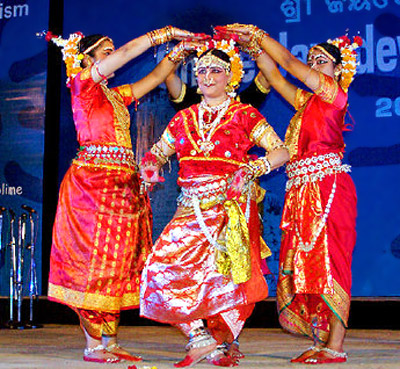
Technique in Kathak is dual in character. It conceives of space only in straight lines. It has only a front-back treatment of space. Spins are executed along a central vertical median from which no shifts are taken place. The weight of the body initially is equally divided and the knees are not loosened. The foot is in the Sama pada. Flat foot dancing is very important in Kathak. The complex foot-work can be executed only through a delicate balance of weight on the flat foot.
The interpretative portion, based on tales of Radha and Lord Krishna and other mythological tradition, contain subtle gestures and facial expressions. Here the torso movements are used frequently; only the shoulder line changes its angle, which appears to be the manipulation of the upper torso. This treatment gives the dance style its peculiar fluidity and some its characteristic torso postures.
The shoulder line and its deflection are used at its best in the execution of movements known as the Kasak masak. The movements of the arms are definite but they do not make any single geometrical pattern. In the basic stance, the dancer holds a variation of the hamsasya hasta above the head, the second arm is extended side-ways or in front and is slightly rounded at the waist level again in the hamsasya hasta. There are many Hastas known to this dance style, where the mushti, sikhara, hamsasya, chandrakala and the alapadma Hastas are the common ones.
The characteristic feature of the dance style is its jumps and pirouettes. There is only a release from gravity, usually in place and there is not attempt on the part of the dancer to cover space forward or backward through the process of the jump. In the bhramaris, the Kathak dancer maintains the axis of the body by using one foot as a centre and the other foot to make a circle. The static foot represents the centre and the dynamic foot is the arm of a compass drawing swiftly the circumference of a circle. Face movements are limited but great emphasis is placed on the movements of the eyebrows. The use of the eyebrows for the lasyanga is a characteristic feature of this dance style. The horizontal side-to-side movement of the neck is used most frequently in Kathak.
When the Kathak dancer moves in front the flat foot is put forward lightly carrying the weight of the body along. The Kathak dancer`s alphabet and vocabulary of dance movements is not built on the principle of either foot contacts, or leg extensions, or knee flexions as in Bharatnatyam. Nor are the cadences built on the principle of weaving patterns in circles, semi-circles or figures of eight of the entire body as in Manipuri. The cadences are directly conditioned by the metrical cycles on which rhythmic variations can be executed. Thus, what is known as the tattakara in Kathak is the ability of the dancer to execute a variety of rhythmic patterns on a basic metrical cycle.