Massage Therapy
  Indianetzone: Largest Free Encyclopedia of India with thousand of articles Naturopathy


in  
Art & Culture | Entertainment | Health | Reference | Sports | Society | Travel
Forum  | RSS Feeds  | Free E-magazine
Naturopathy : Fasting Therapy l Colour Therapy l Sleep Therapy l Aromatherapy l Water Therapy l Massage Therapy l Mud Therapy l Magnetic Therapy l Nature Cure Treatments l Bath Therapy l Indian Naturopathy l Magnet l Music Therapy l Flower Remedies l Weight Loss l Diet Therapy l Diseases of the Nervous System l Oushadhi l Unani Medicine in India
Home > Health > Naturopathy > Massage Therapy
Massage Therapy
A massage involves the scientific manipulation of the soft tissues of the body.

An excellent form of passive exercise is massage Therapy. Massage Therapy involves the scientific manipulation of the soft tissues of the body, which if done correctly, can be highly stimulating and invigorating. Massages have been used from the ancient times, as old as 400 B.C and yet been used as a mode of treatment for many ailments, since it has restored many a sufferer to health and vigour.

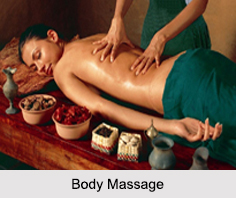
The general massage, dealing with all parts of the body, is highly beneficial in many ways. It tones up the nervous system, influences respiration and quickens the elimination of poisons and waste material from the body through the various eliminative organs and also boosts blood circulation and metabolic processes. A massage removes facial wrinkles, helps to fill out hollow cheeks and neck and eases stiffness, sore muscles and numbness. Cottonseed oil is most commonly used for massaging, but butter is used for filling out cheeks and the neck and also for breast enlargement. If the patient is averse to oil, talcum powder may be used. Persons with excessive body hair should not use oil. General body massage may be done for 40 to 45 minutes and local body massage for 10 to 15 minutes. The oil should be washed off completely after massage. Different body parts can be massaged in distinctive ways for better healing process. These are described as follows:
Massage of the Joints1. Massage of the Joints: In these cases, affected parts should first be bathed with hot water for 15 to 30 minutes and then the massage should be done for a few minutes. Gentle stroking and kneading is recommended on and around the injured tissues. This thus provides additional nourishment to feed the muscular tissues, helping them to grow strong. Massage is employed for eliminating muscle contraction and of breaking of adhesions. A little moderate kneading, and percussion cause muscles to contract and become stronger. Deep circular kneading and vibration loosens the muscles. Kneading under and round the muscles breaks up adhesions.
2. Massage of the Abdomen: Abdominal massage should not be done after a heavy meal, but after two hours or so. The bladder should be emptied before the massage. The patient is made to lie on his back with his knees drawn up. This enables the abdomen wall to relax. The masseur should stand at the right side of the patient and use his finger tips for friction round the umbilical region from right to left. He should likewise alternatively knead the walls and roll with both hands, making deep and firm pressure. He should knead with the hand and finger tips and keep clear of any wound or tender places. He should later take up massaging the larger intestines.

Massage of the AbdomenThe manipulation of the large intestine should begin on the right side. Keep it going upwards and across the transverse colon and move right down on the left side to the sigmoid flexure and rectum. Circular kneading should be done with the help of the three middle fingers. At the same time press into the contents of the abdomen, following the course of the larger colon with a crawling motion. Keep kneading by means of a few circular movements in one spot with the help of fingertips. Keep moving the fingers a little further along. Knead repeatedly. Use ruckles of the hand to make deep pressures along the large colon, moving the hands along after each pressure. Once the kneading of the abdomen is over, follow up by massaging with both hands cupped or use the knuckles of the hand. The patient could also be asked to do some gymnastic exercises for strengthening the walls of the abdomen. Since blood pressure increases during abdominal manipulation, patients with hypertension should avoid abdominal massage. Massage should also be avoided in cases where there has been recent bleeding in the lungs, the stomach or the brain.
3. Nerves Massage: Nerve compression is recommended for soothing nerves. Grasp the limb with both hands, and create firm pressure around and down the arm. Start with the shoulder and proceed down to the wrist. As you leave the grip, bring the hands down a little and make another pressure. As a result, blood circulation will increase. Spinal nerve compression is extremely beneficial. The palm of the hand does it and the vibration of the fingers stimulates it.
Chest Massage4. Chest Massage: Chest massage is helpful in many ways. The patient is made to lie on the back with the arms at the sides. The masseur starts manipulating the chest by means of strokes with both hands on each side of the breastbone. The movement made up and down, moving down the chest, forms a circular motion. Next the muscle kneading is done by picking up the skin and muscles with both hands. Treatment is given to both sides of the chest likewise. Circular kneading is next done by placing one hand on each side of the breastbone and making the circular motions outward towards the sides.
 Back Massage5. Back Massage: The patient is made to lie down with arms at the sides. The masseur effleurages the back from the shoulders downwards using both hands on each side of the spine. Stroking is done from the sacrum upward. Friction follows with each hand at the sides of the spine going down slowly. Next, kneading by muscle picking is done with squeezing. Alternate rapid pushing and pulling movement of the hands sliding down the spine. Circular kneading should also be done. The treatment should end by slapping, hacking and cupping on each side of the spine. Gentle stroking and light kneading of the back is relieving and soothing. Percussion and vibration result into stimulating experience.
6. Massage of the Throat: The patient is made to throw his head back. The masseur places palms of both hands on sides of neck with thumbs under the chin, and fingers under the ears. A downward stroke is next made towards the chest over the jugular veins. Do not exert heavily on the jugular veins. Repeat several times.

(Last Updated on : 5/12/2008)
Recently Updated Articles in Naturopathy
  • Types of Magnets
    The planet earth is full of different types of permanent magnets, which vary in size, shape, design and strength.
  •  
  • Classification of Magnetic Materials
    The magnetic materials are broadly classified into three categories depending on their attraction towards a magnet.
  •  
  • Use of Magnets
    The magnets are very useful in treating various human ailments like toothache, stiffness of shoulders etc.
  •  
  • Affect of magnets in Human Metabolism
    The magnet has its affect on blood and hence it influences the whole human metabolism in a good or bad way.
  •  
  • Magnets in Vedas
    The ancient Atharva Veda has the reference of some magnet like materials in the treatment of various diseases.
E-mail this Article | Post a Comment
Free E-magazine
Subscribe to Free
E-Magazine on Naturopathy

 
Massage Therapy Sitemap
Contact Us   |   RSS Feeds
Copyright © 2008 Jupiter Infomedia Pvt. Ltd. All rights reserved including the right to reproduce the contents in whole or in part in any form or medium without the express written permission of Jupiter Infomedia Pvt. Ltd.