Chakra is a Sanskrit term, which means circle or wheel. Chakra is associated with our psychophysical development and spiritual practice, religious observance and personal discipline. In the Chakra theory the human mind and body is a unique system called the body mind. The charkas are centers of energy within the human body from where energy flows in and out of our aura. Chakras are connected to our physical, mental and emotional interactions and it helps in the development of our self-consciousness. The Chakras are identified through the mystical practice of Yoga, which was very common in ancient India and was known as Kundalini Yoga.
Chakrology is a newly coined term that is associated with the study of Chakras and the term is employed by alternative medicine practitioners. Chakrology comes in various forms such as ancient Hindu or tantric esoteric tradition, new age interpretation or western occult analysis as well as ancient Greek, Chinese and Christian references.
There are many traditional and modern models of the Chakra system of the human energetic body. The difference between numerous models of Chakra is very subtle and they may coexist rather than competing for their existence. The theory is `system theory`, which refers body and mind together as a system and no chakra is marked as a supreme there. No chakra can work alone rather act together as a system and have a very intimate relationship that can easily be compared with our endocrine system, which acts in harmony.
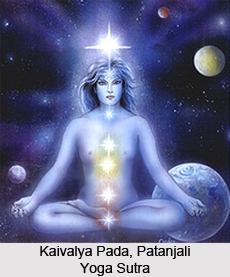
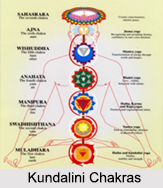
 There are eight Chakras according to Tantric ideology, they are- Muladhara chakra located at the tip of tailbone, Swadhisthana Chakra located in tailbone, Manipura Chakra located in naval, Anahata Chakra situated at the heart, Vishuddha Chakra in neck, Ajna in eyebrow, Bindu at the back of the head, and Sahasra Chakra at the top of head.
The Chakras are present in an alignment through the ascending column from the base of the spine towards the top of head. In modern theory each Chakra is connected with a certain color. In different forms, charkas are associated with consciousness and other distinguishing physiological characteristics. The Chakras are ascribed as lotuses or flowers and the number of petals varies in every Chakra.
Chakras are linked with the vital force of the body and interact with physical, mental and emotional nature of a person. The life energy or `Prana` are said to be accumulated in charkas. So Chakras are loci for shakti( Sanskrit), qi(Chinese), ki (Japanese), coach-ha-guf (Hebrew), bios (Greek) and aether(English). The energy flows from the Chakra through the pathways called `Nadi`. The role of Chakra is to spin and draw the life force to keep the mental, spiritual, emotional and physical health in balance.
Recent studies have revealed that Charkas have a correspondence in position and role with the glands of endocrine system. Thus the west has shown increased interest regarding Chakras.
The seven principal Chakras are placed in different level of body according to the spiritual subtlety, with Sahasrara Chakra at the top connected to pure consciousness and Muladhara at the bottom being concerned with matter.