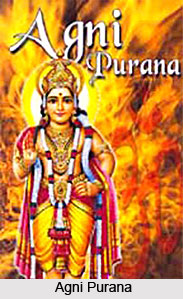
 Agni Purana is one of the eighteen Hindu Puranas which provides a vivid description of the incarnations of Lord Vishnu. It is so called because it is supposed to have been communicated to Vasistha by Agni. It consists of sixteen thousand stanzas distributed in three hundred and eighty three chapters. There are also detailed accounts of Lord Rama, Lord Krishna, Prithvi and the stars. There are a number of verses dealing with cosmology, history, warfare, law, medicine, martial arts, and a lot more. This Purana imparts knowledge on all arts and sciences.
Origin of Agni Purana
To which age this remarkable encyclopaedia or its separate parts belong, it is impossible to say. In spite of the fact that the work itself contains so much that is heterogeneous, there are still many Mahatmyas and similar texts which claim to belong to the Agni Purana, but do not occur in the manuscripts of the work itself.
The encyclopaedic character of the Agni Purana, as it is described, excludes it from any legitimate claims to be regarded as a Purana, and proves that its origin cannot be very remote. It is subsequent to the Itihasas, to the chief Work on grammar, rhetoric, and medicine, and to the introduction of the Tantrik worship of Devi. The materials of the Agni Purana are, however, no doubt, of some antiquity. The medicine of Susruta is considerably older than the ninth century; and the grammar of Panini probably precedes Christianity. The chapters on archery and arms and on regal administration are also distinguished an entirely Hindu character and must have been written long anterior to the Muslim invasion.
Content of Agni Purana
The subject matter of this Purana is two-fold-namely Paravidya, sacred knowledge or theology and Apara Vidya, profane knowledge or the arts and sciences known to the people. The contents of this Purana clearly show that it has no sectarian leaning. It impartially treats the Vaishnava, Shaiva and Sakta forms of worship. It is more a compendium of Sanskrit learning than the advocacy of any particular form of religion. It is classed among the Tamasa or the delusive division of the Puranas.
The early chapters of this Purana describe the Avataras, and in those of Rama and Krishna, avowedly follow the Ramayana and Mahabharata. A considerable portion is given to instructions for the performance of religious ceremonies, many of which belong to the Tantrik rituals and are apparently written down from the principal authorities of that system. Interspersed with these are chapters descriptive of the earth and of the universe, which are same as those of the Vishnu Purana, and Mahatmyas or legends of the holy places, particularly of Gaya. Chapters on the duties of kings and on the art of war then occur, which seem to have been extracted from some older work, as is the chapter on judicature, which follows them, and which is the same as the text of the Mitakshara. Subsequent to these there is an account of the distribution and arrangement of the Vedas and Puranas and, in a chapter on gifts, we have a description of the Puranas, which is precisely the same and in the same situation, as the similar subject in the Matsya Purana. The subject of training in the use of arms and armour is treated in four chapters; of this archery is principally dealt with.
It may be noted that although it commences with Vishnu, gives directions for the ritual of the Vishnu cult and contains a Dvadasasahasri Stotra to Vishnu (Chapter 48), it is yet essentially a Shaivaite work and deals in detail with the mystic cult of the Linga and of Goddess Durga. It also gives instructions for the production of images of gods and their consecration, and refers to the cult of Ganesha (Chapter 71) and the sun-cult (Chapter 73). A few chapters (368-370) deal with death and transmigration and Yoga (371-379), Chapter 380 contains a summary of the doctrines of the Bhagavad Gita, and Chapter 381 a Yamagita. But the cosmological, genealogical and geographical sections peculiar to the Puranas are not missing.
It can be concluded that the Agni Purana is a detailed discourse given by Agni to sage Vasistha regarding various aspects of human life. The especially distinctive feature of this Purana is its encyclopaedic character. It actually deals with anything and everything. As has been seen, there are sections on geography, astronomy and astrology, on marriage and death customs, on omina and portenta, house building and other usages of daily life, and also on politics (niti) and the art of war, on law (in which it is closely connected with the law-book of Yajnavalkya), on medicine, metrics, poetry, and even on grammar and lexicography. The Agni Purana is valuable as embodying and preserving relics of antiquity, although compiled at a more recent date.
