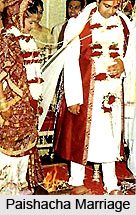
 Paishacha marriage is the eighth and last type of Hindu marriage. It is considered as the most inferior type of marriage. In this type, the girl`s wish is not considered whether she wants to marry or not instead she is forced to marry and even the bride`s family is not given anything in cash or kind. She is seized against her wish. And the marriage is done against the wish of the girl and her family. Men would marry a woman, whom he had seduced while she was asleep, intoxicated or insane. This kind of marriage was later prohibited.
This was the worst form of all types of marriages. In this, the bride was abducted, but not in a fair fight with her tribe. She was molested or stolen, when she and her relatives were asleep, or in a state of intoxication during a tribal festival. This form is universally condemned. The inclusion of this form of marriage in Hindu Sutras can only be justified on the ground that it was so prevalent among the primitive tribes that the Sutras could not have avoided its inclusion. By recognition of this form, the only advantage was that the children could be regarded as legitimate.
According to Kautilya, "Of these eight forms of marriage, only the first four (Brahma, Daiva, Arsha and Prajapatya) are ancestral customs of old and are valid on their being approved by the father. The rest, for it is that they receive money, the money paid by the bridegroom for their daughter. In case of absence by death of either the father or the mother, the survivor will receive the money. If both of them are dead, the maiden herself shall receive it. Any kind of marriage is approvable, provided it pleases all those that are concerned with it." And these forms of marriages are valid, only if they have been approved by the father in a lonely place if a girl is met while sleeping or she is mad etc., and someone outrages her modesty. It is also not admitted by learned persons and is not religious.
Marriage is the basis of all disputes. The giving in marriage of a virgin well-adorned is called "Brahma-marriage." The joint performance of sacred duties by a man and a woman is known as "prajapatya-marriage." The giving in marriage of a virgin for a couple of cows is called "Arsha-marriage." The giving in marriage of a virgin to an officiating priest in a sacrifice is called "Daiva-marriage." The voluntary union of a virgin with her lover is called "Gandharva-marriage." Giving a virgin after receiving plenty of wealth is termed "Asura-marriage." The abduction of a virgin is called "Rakshasa-marriage." The abduction of a virgin while she is still asleep and intoxicated is called "Paisacha-marriage." Of these, the first four are ancestral customs of old and are valid on their being approved of by the father. The rest are to be sanctioned by both the father and the mother; for it is they that receive the money paid by the bridegroom for their daughter.
So looking at all the eight types of marriages, it can be said that there are two extreme at two ends. It is true that there cannot be same and uniform rule for everybody. The Hindu shastras has divided each type according to the social structure and system.
Paishacha Marriage
Paishacha marriage is the most inferior type of marriage. In this type of marriage the girl’s wish is not given any kind of importance.