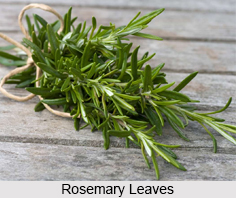
 Rosemary Leaves provide a pungent and lingering aroma which also adds flavour to a large number of unusual foods as well as several every day non-vegetarian and vegetarian dishes. The dried leaves are popular as flavouring agent and spice. Freshly sliced Rosemary leaves impart a flavour to jam, sweet sauces and herb butter. It is also used in preparing cheese, biscuits, soup, sauces and various non-vegetarian foods. Rosemary leaves possess high medicinal value. It helps in digestion and also refreshes the body and mind.
Etymology of Rosemary Leaves
The botanical name of this shrub is "Rosmarinus Officinalis" and it belongs to the family "Lamiaceae". It is known as "Rusmary" in Hindi language. Rosemary was named by the 18th century naturalist Carolus Linnaeus. The name of rosemary has originated from the Latin words "Ros Marinus".
Origin of Rosemary Leaves
Rosemary is not a very popular herb in India. It was perhaps introduced in India by Europeans as garden plant mainly for its pleasantly fragrant leaves, limited only in cool places and hill stations where the colonial rulers used to stay during the summer season.
Description of Rosemary Leaves
Rosemary is a leafy, exotic and evergreen shrub which grows up to a height of 2 meters. It has narrow leaves and few flowers in axillary racemes; white or bluish or pale violet; smooth nutlets, ovoid sub-globose. The leaves of Rosemary are narrow and are about 2.5 centimetres in length, and they look like curved pine needles. Rosemary grows well on friable loam soil with good drainage in complete sun. It grows best in neutral to alkaline conditions (pH 7-7.8) with good fertility.
 Composition of Rosemary leaves
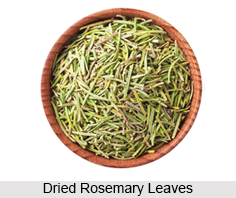
The leaves of Rosemary contain tannin, saponin, ursolic acid, amyrins, betulin, carnosic acid and rosemarinic acid. The dried rosemary leaves, on steam distillation, yield 1 to 2 percent of a volatile oil, known in the trade as "Oil of Rosemary", used in perfumery and medicine. A phenolic fraction possessing anti-oxidant properties has been isolated from the leaves and also from the oil. The dried rosemary leaves contain:
•5.7 percent moisture
•4.5 percent protein
•19 percent fibre
•47.4 percent carbohydrates
•6.0 percent total ash
•1.5 percent calcium
•0.70 percent phosphorus
•0.03 percent iron
•0.04 percent sodium
•percent potassium
Vitamin A – 175 I.U/100 gram
Vitamin B – 1:0.51 mg/100 gram
0.04 percent Vitamin B2
1.0 percent Niacin
Vitamin C – 61.3 mg/100 gram
Calorific value – 440 calories/100 gram
Use of Rosemary Leaves in Food
Fresh tender tops are used for garnishing and for flavouring cold drinks, soups, pickles and other foods. Rosemary leaves are also used as a condiment; powdered and dried, the leaves are added to von-vegetarian as well as vegetarian dishes, jams and preserves. It is also used in preparing Rosemary tea.
Benefits of Rosemary Leaves
Rosemary water betters the skin, and is also used as a hair wash. It also helps in the growth of hair. It cures weak digestion, flatulence, neuralgic pains and the circulation of blood is stimulated by the use of rosemary. Each and every part of the Rosemary plant is sour or bitter in taste and it serves as a good stomachic and a nerving tonic. It widens the tissues where it is applied and also acts as a room freshener. Rosemary Oil is used primarily in cheap perfumery, hair lotions, scenting of soaps and denatured alcohol. The oil of Rosemary is used in medicinal preparations and has been used as a carminative. The oil exhibits anti-bacterial activity. Dried Rosemary leaves are smoked for the relief of asthma. Rosemary leaves are used for vapour baths for the relief of paralysis, rheumatism etc.
