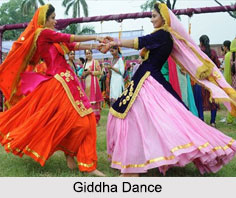
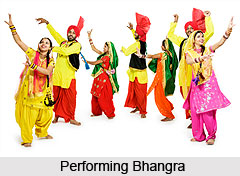
 Bhangra, a folk dance form, is performed with zest, enthusiasm and energy. It is one of the most lustrous forms of dance that engulfs one`s creative liberty to an altogether different level. Bhangra is originated from the land of five rivers, popularly known as Punjab, situated in the Northwest region of the Indian Subcontinent. In its present form it has become very popular in Jammu and Kashmir, and parts of Himachal Pradesh, Haryana and Pakistani Punjab. Men perform Bhangra, while the ladies perform their own fierce, elegant, dance called Giddha. Bhangra has evolved to a popular style of music and dance that people perform throughout South Asia and many parts of the world.
Origin of Bhangra Dance
The origin of Bhangra can be traced back to as long as 500 years, although it may have existed much earlier. The basic movements of Bhangra is related to the farming activities like ploughing, sowing, harvesting and were generally performed for celebrating the harvesting season .In the late 1960s and 1970s, several Punjabi Sikh bands from the United Kingdom prepare the stage for Bhangra to become a form of music instead of being just a dance.
Performance of Bhangra Dance
The Bhangra season starts with Baisakhi, a festival that reflects the joyous mood of the farmers for there last season`s success and also for the advent of the new season, that falls on April 14th every year to mark the beginning of the solar year. Hence it is also celebrated as New Year among the Punjabis and many other communities. Nowadays because of its huge popularity people perform Bhangra in all parts of the world at occasions such as weddings, receptions, and parties.
 Music of Bhangra Dance
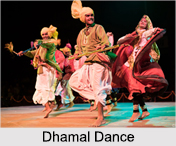
The music of Bhangra is really vibrant and it has an intoxicating effect on the listeners. The music brings out the free spirit and un-inhibited flow of emotions that allows people to move the bodies in an energetic way that results in tremendous joy and releases tension The major sub genres of Bhangra are Dhamal, Jhumar, Daankara, Luddi, Giddha, Julli, Gatka, Saami and Kikli. All these sub genres follow different dance formats and together they combine to form an all-round view of original Bhangra.
It is generally played with a Dhol beat with a single-stringed instrument called the Iktar (Iktara), the Tumbi and the Chimta. The songs played with the dance form are written in small phrases in Punjabi language called `Bolis`. The songs are generally based on current issues social or regional that are faced by the singers what they want to convey to the people.
Costumes of Bhangra
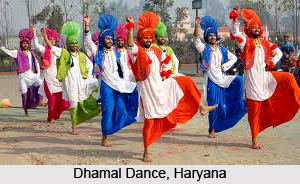
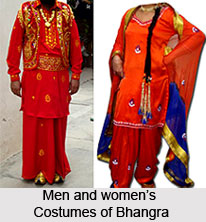
Costume is an important part in any performance and more so in Bhangra as it transfuses energy from the vibrant colours of the costumes that are generally used by the dancers. Traditional men wear a Chaadra while doing Bhangra. In addition they also wear Kurta, and Pugerdee. In recent times, men wear Turla and Fumans (small balls attached to ropes) are used on each arm.
Women wear a traditional Punjabi dress known as a Ghagra and dupattas, colourful pieces of cloth wrapped around their neck. Women also wear suits called Salwar Kameez Dupatta. There are other types of costumes that are used while performing Bhangra like, Kaintha, rumal are also used while performing Bhangra. The rumals look very elegant and are effective when the hands move during the course of Bhangra performance.
Bhangra is truly becoming more popular worldwide and people of non-Punjabi background are listening to and performing Bhangra. Universities and other organisations are holding annual Bhangra dance competitions. The idea of any dance form is to spread the message of love and peace with there lyrics and dance forms and entertain the audience and also enhances the mood of the performers, in which Bhangra seems to be leading the path. It can be visualised that the popularity of Bhangra is growing day by day with more regions to cover.