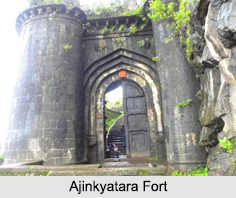
 The Ajinkyatara Fort is located in the Sahyadris Mountain Range in the state of Maharashtra. It is situated on the Ajinkyatara Mountain which is one of the 7 mountains bordering the city of Satara in the state. It was built during the 16th century and was mostly under the rule of the Maratha Empire. Standing at an elevation of 3,300 ft above sea level, the fortress was once a watchtower guarding the Satara city and offered a panoramic view of the city.
History of Ajinkyatara Fort
The Ajinkyatara fort is considered as one of the most prominent historic sites in the state of Maharashtra. The fort was constructed by Bhoj Raj II of Panhala between 1178 and 1193. Initially, the Ajinkyatara Fort was used as a prison and from 1580 to 1592; the famous Chandbibi was kept as a prisoner on this fort. Records state that in 1673, Chhatrapati Shivaji Maharaj took control of this fort from Adil Shah of Bijapur, and further Aurangzeb ruled this fort between 1700 and 1706. The fort at Ajinkyatara was occupied by Shahu Maharaj in 1708 and it remained under the control of the Maratha ruler until the year 1818. The defensive structure was built at a strategic location which provided a view of the entire Southern Maharashtra. Maharani Tarabai, a queen of the Maratha Empire, was held captive in the fort by Shahu Maharaj.
The fortress is also mentioned in Nathmadhav`s novel "Veer Dhaval", in which the eponymous protagonist, a vassal of the Chalukya, is the rightful master of the fort which has been under the misrule of his uncle Chanda Varma, who usurped the fort after murdering the protagonist`s father Keerti Varma.
Major attractions near Ajinkyatara Fort
Few of the popular attractions in the Ajinkyatara Fort are hiking, trekking and mountaineering. On the northeast side of the fort are the temples of Devi Mangalai, Lord Shiva and Lord Hanuman. Nandgiri and Chandan-Vandan forts on the east and Jarandeshwar and Yawateshwar hills on the west can also be seen from the fort. There are several water reservoirs and tanks inside the premises of the Ajinkyatara Fort. This helped in storing and supplying water to the inhabitants of the fortress. Thus there was no scarcity of water in the fort even though it was located at a high altitude.
Listed below are some of the major nearby attractions at Ajinkyatara Fort:
Nataraj Mandir: Nataraj Mandir is a beautiful temple of Lord Shiva situated inside the premises of Ajinkyatara fort. The temple has an idol of lord Shiva in his Nataraj avatar. It has 4 entrances in all four directions. It is also called Uttar Chidambaram Shri Nataraj Mandir.
Sangam Mahuli: Close to Ajinkyatara fort, the Sangam Mahuli is a confluence of river Krishna and Venna. With its soothing flow of water the confluence gives an enthralling experience to touring visitors.
Sajjangad Fort: Sajjangad is a splendid fort that was once home to the great Maratha kings and their army.
Dams: The Ajinkyatara fort has a string of dams in its vicinity. Prominent among them are the Koyna, Kanheri and Dhom Dam.
Waterfalls: The fort has a number of scenic waterfalls in its adjacent areas.
Visiting Information on Ajinkyatara Fort
Ajinkyatara fort is only 115 km from Pune and 285 km from Mumbai. The place is well connected to the major cities of Pune, Mumbai and Kolhapur. The quality of road is excellent and both state and private buses can be used to reach the fort. Satara is well connected by both railways and roadways with Pune, Sangli, Miraj and Kolhapur. Satara railway station is the closest railway station that is well linked with Mumbai and Pune stations. Pune and Kolhapur are 2 of the nearest airports to Satara.