 Aurangzeb was the 6th Mughal Emperor, who was widely considered to be the last notable and effective ruler. His rule lasted for about 49 years from 1658 to until his death in 1707. The year of his death is considered to be the end of Medieval Indian History and the beginning of the Modern Indian History. This is because his death marked the decline of the Mughal Empire and the start of European dominance over India.
Location of the Tomb of Aurangzeb
The tomb of Aurangzeb is located in the village of Kuldabad in the district of Aurangabad in the state of Maharashtra. It is located in the south-eastern corner of the complex of the dargah of the Sufi saints Sheikh Burhan-u"d-din Gharib and Sheikh Zainuddin, who were his spiritual gurus.
History of Aurangzeb"s Tomb
Unlike his forbearers, Aurangzeb refused to use the royal treasury at his disposal. He instead chose to knit caps and copy the Quran anonymously and used the proceeds from the sales for his personal expenses. It is said that instead of using the royal treasury, he funded his resting place with only 14 rupees and 12 annas that he earned from his personal endeavours.
Structure of Aurangzeb"s Tomb
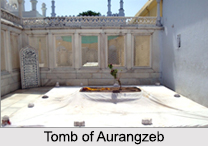
The tomb of Aurangzeb is simpler than one would expect from a Mughal Emperor. Aurangzeb asked for a modest, open-air grave which showed his deep devotion to his Islamic beliefs. The translated Persian epitaph on his tomb reads: "The rich may well construct domes of gold and silver on their graves! For the poor folks like me, the sky is enough (of a dome to shelter my grave)!"
The platform over the tomb is made of red sandstone, which is less than 3 yards in length. The tomb has been covered with soil on which herbs grow. After Aurangzeb"s burial, he was given the posthumous title of Khuld-makan, which means he whose abode is in eternity. In 1911, a marble structure was erected around the grave under the orders of Lord Curzon. The tomb is remarkably plain and the perforated marble screens on three sides are the only elements of decoration.
The dargah also houses the tomb of Aurangzeb"s son, Azam Shah and his wife; along-with the tomb of Asaf Jah I, who was the founder of the Hyderabad dynasty.
Visiting Information on Aurangzeb"s Tomb
The nearest airport is at Aurangabad. Jalgaon is the closest railway station which is connected to other parts of Maharashtra. However, Bhusaval, about 30 km from Jalgaon is well connected to all parts of India.