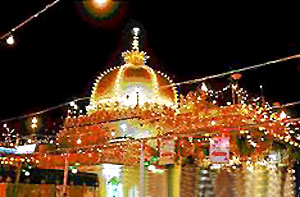
 Garib Nawaz Urs commemorates the death anniversary of Khwaja Muinuddin Chishti. It goes on for six days. Long night qawwali song also takes place. This festival is celebrated in the seventh month of Islamic lunar calendar. This festival started in 1212 A.D. It is celebrated in the first week of Islamic month of Rajab which is the seventh month in the Islamic calendar.
Drums are beaten which indicate the start of the ceremony. The celebration starts with the hoisting a white flag by the member of Chistis on dargah. This is followed by opening the gates known as Jannati- Darwaza. It is believed that one can ensure a place in "jannat" if one crosses the gate seven times. The tomb is consecrated by sandal wood and paste. Sweet perfume is sprayed on it. The tomb is covered with an embroidered silken cloth. Fatiha and Salamati recitations are rituals. The word urs comes from uroos which means meeting of an individual with the God.
It is believed that Muinuddin Chishti spent the last six days of his life in isolation in a Huzra and he died on the sixth day of Rajab. The sixth day of the festival is considered as the most auspicious and is known as "Chhati Sharif". On sixth Rajab the festival is celebrated between 10:00 A.M. and 1:30 p.m. inside the Mazaar Sharif. The Shijra is read by Khadims of Moinuddin Chishti which is followed by prayers. Before conclusion of Chhati Sharif, Badhaawa or a poem of praise is sung at the main entrance of the shrine by Qawwals. This is accompanied by clapping only and no musical instrument is played. Badhaawa was composed by Syed Behlol Chishty who was an ancestor of the present day Khadim community. After reciting this, the Qu`l ceremony comes to an end and Fatiha is recited. The ceremony comes to an end by firing cannon at 1:30 p.m.
The main entrance of the Holy Tomb which is generally kept closed at night is kept open through out the day and night excepting two or three hours at night during the six days of Urs festival. All other daily programmes are suspended and few functions and ceremonies commence from that night.
On the day of Qul ceremony after the Morning Prayer, people start gathering at the holy Tomb. The activities include recital of Holy Quran, Darood, Shijra-e-Chishtia and other verses. People tie small turbans on each other`s head and pray for peace and happiness.
Another interesting aspect of Urs in Ajmer is the plundering of the milk pudding that is cooked in two capacious cauldrons. This blessed food is generously distributed among the devotees.