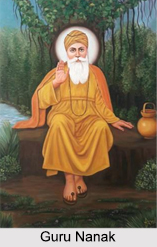
 Guru Nanak Dev Ji is known as one of the most popular saints in India and also the youngest founder of Sikhism. Guru Nanak has established the religion of Sikhism in India and spread his idealism all over the world with the help of his disciples. He has followed almost all the methods like gentle persuasion, humour, sarcasm and even admonition to get his point across and spread the Sikh faith.
Nature of God
According to Guru Nanak, there is one God. He is supreme truth. He is the creator. He is omnipresent. He is not born. He is formless, unseen, infinite, inaccessible, inapprehensible and pure. His teachings are popular among his followers. His first statement after his prophetic communion with God was "There is no Hindu, nor any Mussalman". This is an announcement of supreme significance. It declared the brotherhood of man and the fatherhood of God.
Langar
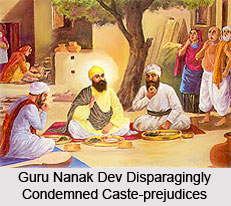
Guru Nanak became successful to lay the foundation of a casteless society by starting the institution called Langar, with the active support of his wife, Mata Sulakhni. Nanak actually elevated the works like preparing meals, cleaning, cooking, serving and finally washing the utensils, to the level of service to the community.
Sangat and Pangat
The concept of Sangat and Pangat was also introduced by Guru Nanak as the means to fight against the caste system and inequality that was prevailing in the Indian society at that time. He successfully used these two aspects to spread his idealism among his disciples and also to establish his thoughts effectively. These two are considered as two of the most important and significant aspects of Guru Nanak`s teachings of Sikh faith.
After establishing an equal society in Kartarpur, Guru Nanak then started to look for his successor, who will be carrying his messages to the common people in the upcoming years. He was looking for successor, because he felt that there was still a lot to be done for his mission, as he had laid only the foundation of a new egalitarian faith, and set up a nucleus of a regenerated society. The society was still needed to be nurtured and guided and made stable and self-reliant. Guru Nanak found a devotee named Lehna among all the devotees, who came to Kartarpur and he was quite impressed with Lehna. Lehna also soon became an ardent disciple of Guru Nanak and actively took part in all activities of Langar. Guru Nanak examined the patience and devotion of his two sons, Srichand and Lakhmidas and also of Lehna by employing them in various laborious works, before finally selecting his successor. Nanak eventually selected Bhai Lehna as his successor and named him "Guru Angad" after passing him the responsibilities to take forward his mission. Thus, Guru Nanak founded the base of a religion that had travelled a long journey so far and is flourishing in its own till today.
Guru Nanak left his earthly abode on 7th September, 1539, at the age of 70.
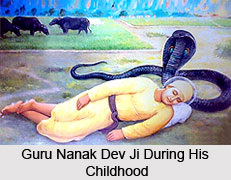 The founder of Sikhism, Guru Nanak was born in the year of 1469 in a village named Rai Bhoen di Talwandi, situated in Sheikhupura district of Pakistan, 65 km west of Lahore. According to some of the scholars, Guru Nanak was born in the middle of the month of Baishakh, Indian calendar on 15th April, 1469. However, his disciples traditionally celebrate his birthday on the full-moon night of the Indian month of Kartik, which falls in the months of October/November. His father`s name is Kalu Bedi and mother`s name is Tripta. His father was a revenue official in the village and a well-known person in the society.
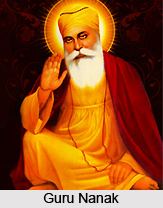 Guru Nanak, the founder of Sikhism, was born in a small village in a Hindu family and became spiritually inclined at a very early age. His entire life was spent in teaching the postulates of Sikhism. He travelled far and wide to propagate the philosophy which later came to be known as the Sikh philosophy. The account of Guru Nanak`s early life can well be learnt from the Janam Sakhis. All the Janam Sakhis stand as biographical accounts of Guru Nanak. The Miharban Janam Sakhis provides the details of Nanak`s early life. It gives account of Nanak`s birth. The background of his family is also included in the Janam Sakhis. It also mentions every detail right from the time of his birth. The Janam Sakhis mention that right from the age of five he had distinctly showed his spiritual inclination. This Janam Sakhis also describes how at the age of nine, Nanak, rejected all kinds of external rituals and emphasised on the inward acceptance of the Almighty. As this Janam Sakhi proceeds it gradually gives account of the life of Nanak. It gives account of Nanak`s family as well as his growing spiritual tendencies.
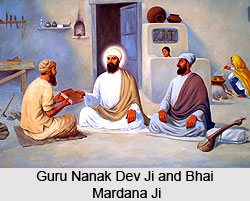
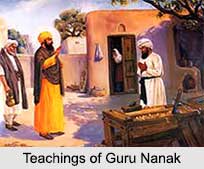 Teachings of Guru Nanak reflected his deep philosophical understanding. He spread the message, "There is no Hindu, no Mussalman" and also said that "All are creatures of God and His creation". Guru Nanak strongly believed in the view that there is only One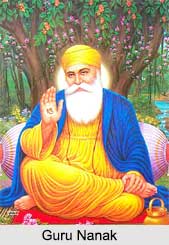
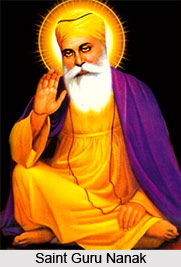 Guru Nanak, the first guru of the Sikhs stated that the Lord is the Universe. He is the Creator and the Sustainer. God exists beyond time and is responsible for His own manifestation. For a
  Langar is an open expression of Vand chhako. Sikh giving in the form of daswand, supports the concept of langar. Daswand, vand chhako and langar are the practical expressions of the life of a Gurmukh. Langar was commenced by Guru Nanak Dev as a token of human brotherhood or sisterhood as well as to help those who are in need. Angad Dev who was the second Guru followed this practice. However the third Guru Amar Dasji institutionalized this. The tenth Guru Gobind Singh ordered his followers to start at a personal level. This would ensure that nobody may go hungry.
 The concepts of Sangat and Pangat are two of the most important and significant aspects of Guru Nanak`s teachings of Sikh faith. He successfully used these two aspects to spread his idealism among his disciples and also to establish his thoughts effectively. He mainly used Sangat and Pangat to establish his thought of One God and equality of all the human beings, something that was almost unthinkable in his period of time.
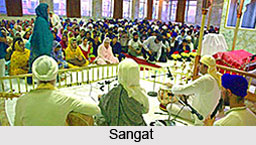
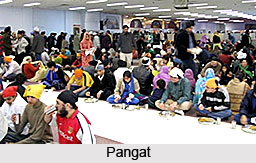 Guru Nanak made the Sangat a regular feature of the new city of Kartarpur that was set up by himself to stay permanently and spread his idealism. There were around three daily prayers recited at Kartarpur everyday - during the sunrise, sunset and just before going to sleep. The Sikhs used to recite the first two prayers in a group and they used to recite the last, individually. The venue of the Sangat was called as a Dharamsala and it was actually the precursor of gurdwaras. The people who joined the Sangat were made to sit together in the same row and the row was named as the Pangat. They also used to eat together, regardless of who is coming from which caste. Guru Nanak got significant success in breaking one of the most potent taboos of class discrimination through the concept of sangat and pangat.