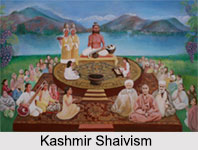
 Kashmir Shaivism is one of the most highly developed schools of Indian Philosophy. It developed between the 7th and 12th Centuries of the Christian era. Kashmir Shaivism is not a religion. It is a philosophy open to those who have the desire to understand it; hence, for its study there are no restrictions of caste, creed or colour.
Literary Sources of Kashmir Shaivism
All the important works on this philosophy are written in Sanskrit language. There are a few translations of some minor works on Shaivism available in English. The "Pratyabhijna Vimarsini" of Abhinavagupta, the most important work on the subject, has recently been translated into English and has been published also. But it remains a fact that one cannot still learn much about Shaivism even after studying this rendering. Only a person who can understand the original Vimarsini in Sanskrit can fully understand that translation with the help of the original Sanskrit.
Trika Philosophy of Kashmir Shaivism
Kashmir Shaivism is also called "Trika Philosophy", the three-fold scene. This threefold science is based on the three Energies of Lord Shiva. These three Energies are;
i. Para (Supreme): Para means the Supreme Energy of Lord Shiva, otherwise known as his Subjective Energy.
ii. Parapara (Intermediate): Parapara is the medium, the Intermediate Energy of Lord Shiva. It is called his Cognitive Energy.
iii. Apara (Inferior): Apara is Lord Shiva"s Inferior Energy and is referred to as his Objective Energy.
Purpose of Trika Philosophy in Kashmir Shaivism
It is believed that the human being resides in the Inferior or Objective Energy of Lord Shiva. As long as one resides in Objective Energy, one is the victim of sadness and sorrow, and is entangled in the wheel of repeated births and deaths. So one has to emerge from Objective Energy and enter into Subjective Energy, in which one is liberated from all this sadness, and becomes absolute in the attainment of final beatitude. This Trika Philosophy of Kashmir Shaivism teaches one how this individual being immersed in Inferior, Objective Energy can be carried towards the Supreme, Subjective Energy of Lord Shiva through his Cognitive, Intermediate Energy. So the purpose of studying this Trika system is to rise from Objective Energy through Cognitive Energy and finally be one with the Subjective Energy of Lord Shiva.
Path of Consciousness in Kashmir Shaivism
In order to achieve this state, there are three means which have been laid down by Trika thought. These means lie within the sphere of Cognitive Energy, for it is Cognitive Energy alone that can carry one towards the Subjective Energy of Lord Shiva. The purpose of Cognitive Energy is to develop the limited being"s capacity and ability to receive God-consciousness. In the body of Cognitive Energy, as has been said, are three means. The first and supreme means is called "Shambhavopaya". The second, intermediate means is called "Shaktopaya" and the third, inferior means is called "Anavopaya". These means are handled and practised according to the ability of the seeker.
Shambhavopaya: Shambhavopaya is that path wherein the individual has to do away with all the various long-winded procedures such as recitation of Mantras, of Sadhana based on breathing, meditation on particular deities, concentrating on some spiritual thought and so on. One only has to develop his awareness of Consciousness. By the constant awareness of this Consciousness, the individual "I" consciousness fast disappears and it is united with God-consciousness.
Shaktopaya: Shaktopaya is the means in which the aspirant or seeker has to develop concentration upon God-consciousness by means of some particular spiritual thought bestowed by the master. Here the Sadhaka has to concentrate on that particular thought of God-consciousness without the support of Pranayama, Mantra and so on. He must develop God-consciousness simply and only by meditating upon this thought that will carry him to the Supreme State and Transcendental being.
Anavopaya: Anavopaya is that means in which a Sadhaka who is endowed with an inferior capacity of mind and meditation must develop God-consciousness by resorting to meditation. This is done with the practice of Pranayama and the recitation of Mantras. In this third inferior path, a Sadhaka has to develop God-consciousness by seeking the support of the inferior methods like Pranayama that finally carries one to God-consciousness, in the end.
Kashmir Shaivism remained confined within the boundaries of Kashmir. The Punjab and all other frontier regions of India were frequently attacked first by Huns and then by Pathans in those centuries and, therefore, scholars and students could not come to, or go from, Kashmir freely and safely in those times. For this reason, knowledge of this most important school of Indian philosophy got itself confined to the boundaries of the Valley of Kashmir and could not spread in other parts of India. It is on account of this fact that the Shaivism of Kashmir is very little known to scholars outside Kashmir even to this day.