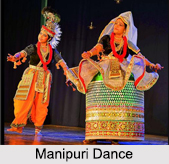
 Manipuri Dance has its origins in the North-eastern states of India. It echoes the rhythm of life amidst its grace and charm. Manipuri as a dance form is old but is the youngest among the Indian classical dances. The current form of this dance is much more free and limited only to the literary word and the rigidity of the Tala.
Origin of Manipuri Dance
The origin of Manipuri dance can be traced back to ancient times that go beyond recorded history. Manipuri dances sustained such ritual practices that were prevalent in the region. The ritual dances were of devotion and dedication to a deity. The evolution of this dance form was due to a mutual interaction between the earlier ritualistic dances and the Vaishnava Bhakti cult. In the 18th Century, a king of Manipur named Garib Nivas embraced Vaishnavism though the ground had been prepared by earlier Vaishnava missionaries. Sant Dass of Bengal left the deepest impact on the people. Meities assimilated the Vaishnava tradition but the older forms of Manipuri and themes were never given up. The result is a rich repertoire, divided into two clear parts. The first consists of the Meities dances, such as the Lai Haroba and the Khamba-Thoibi, while the second includes the Vaishnavite dances which chiefly present the varieties of rasa dances and the bhangis.
Theme of Manipuri Dance
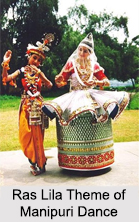
Grace, divinity and a seamless majesty that characterize Manipuri Dance. The Indian religious themes and the devotional aspects of Indian philosophy and religion shape the dance pattern. The Radha Krishna RasaLeela accompanied with the throbbing beat of the Manipuri Dholak enriches the devotional attribute of Manipuri Dance. Themes from Vishnu Purana and Geeta Govinda form the rhythm of the Manipuri Dance. The Vaishnava cult and the Bhagwat Purana also gain an articulate dimension amidst the vigorous masculinity and the gentle feminine touch of the Manipuri Dance.
 Style and Technique of Manipuri Dance
The style and technique of Manipuri Dance style is illustrious by its stress on the expression of moods and sentiments and through elegant body movements. Its aim is to make rounded movements thereby avoiding jerks, sharp edges and straight lines. This movement gives this dance a soft appearance. The foot movements also play a very important role in this dance. The dancer puts his or her feet down with the front part touching the ground first. The ankle and knee joints are also used. The head, the hands, and the feet move together in harmony. While the men"s dancing style is swift and vigorous and is characterized by leaps and sitting positions; the women"s dancing style on the other hand, is distinguished by smooth and gliding feminine movements.
Music in Manipuri Dance
Music in Manipuri dance is bound by sheer technicalities of this dance form. Short musical compositions like the swarmala, the chaturang, and the keertiprabhand form an important part of the dancer`s repertoire. The Pung, varieties of drums, wind instruments like the flute, conch shells and a trumpet-like horn provide music for this dance. Stringed instruments like the Esraj, tambura and Pena offer the main melody. The cymbals provide an additional rhythmic effect to the overall dance style. The lyrics used in Manipuri are from the poetry of Jayadeva, Chandidas, Vidyapati and many more. Sanskrit, Maithili, Braj bhasha are the languages used.
 Costumes in Manipuri Dance
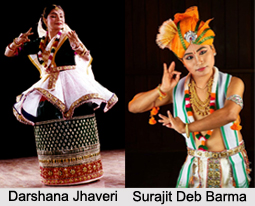
Rich and vibrant colours with attractive jewelleries are used as Manipuri dance costumes. "Patloi", is the typical costume of the female dancers. The lehenga is called "Kumin" with mirrors and zari work intricately woven into beautiful designs. It is layered with a transparent silk. A velvet choli is used with tight trimmed sleeves which are embellished with zari, silk or gold embroidery. The face is covered with a transparent Odhni. The transparency ensures the visibility of the facial expressions. The dancer wears round shaped jewellery or garlands of flowers to adorn her face, hand, neck, waist and legs that synchronize well with her costume. The women also wear a tight-fitting cone-shaped cap, decorated with a border of synthetic pearls, under a thin white veil. In "Rasa Leela", the Gopis wear a red dress while Radha stands out in green attire. Krishna is seen wearing a pleated dhoti of gold or saffron silk with embroidered bands across his chest.
Manipuri Dancers of India
Guru Bipin Singha is called the “Father of Manipuri Dance and styleâ€. The Jhaveri sisters – Nayana, Suverna, Darshana and Ranjana Jhaveri are well known Manipuri dancers in Mumbai. These artists have spread the beauty of Manipuri Dance all over the world and have been honoured both nationally and internationally on this subject. Other well known performers of Manipuri Dance are Sohini Ray and Poushali Chatterjee.