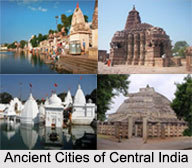
 Ancient Cities of Central India gives the detailed description of the downfall of Maurya Empire, the rise of Buddhism in Gupta period, the rise and downfall of Eastern Ganga Dynasty in Odisha and Chattisgarh and the ancient kingdom of Vidisha.
Ujjain
Ujjain, once the ancient city in Madhya Pradesh, now converted into a largest city in Ujjain district of Madhya Pradesh. The ancient Ujjain was situated on the eastern bank of the Kshipra River. Ujjain was the most prominent city on the Malwa plateau of central India for much of its history. It emerged as the political centre of Central India around 600 BC. It was the capital of the ancient Avanti kingdom, one of the Sixteen Mahajanapadas. Later, it was developed by the Mauryan Emperors. Ujjain was an important literary centre of ancient India, called Adyapeetha, or foundation of Sanskrit learning, ethics, knowledge, science and art, and has been called, "Swarna Sringa", in local parlance, due to the golden towers of the many temples in this temple city
Vidisha
The ancient city of Vidisha was the seat of different regional kingdom, which later merged into the power kingdoms of the Central India. Vidisha is situated east of the Betwa River, in the fork of the Betwa and Beas rivers, 9 km from Sanchi. The town of Besnagar, 3 km from present-day Vidisha on the west side of the river, became an important trade centre in the 6th and 5th centuries BC, under the Sunga Dynasty, Naga Dynasty, Satavahana Dynasty, and Gupta Dynasty, and was mentioned in the Pali scriptures. Emperor Ashoka was the Governor of Vidisha during his father`s lifetime.
Mandu
It was mentioned in the regional scriptures, that Mandu was the important centre of learning in early India. But in medieval era, Mandu became the hot spot of Central Indian politics. Mandu was flourished in 6th Century BC. But Mandu gained prominence in 10th and 11th century under the Paramara Dynasty. Now Mandu has many places of attractions like The Darwazas, Hindola Mahal, Jahaz Mahal, Hoshang Shah`s Tomb, Jami Masjid, Darya Khan`s Tomb complex, Roopmati`s Pavilion, Baz Bahadur`s Palace. The places of attractions are inspired from Pashtun architecture.
Jabalpur
Jabalpur is known as "City of Marble". This ancient city was formed in 300 BC. The Ashokan relics dating to 300 BC have been found as evidence of the Maurya Empire (322 to 185 BC). Jabalpur became a city-state before it was ruled by the Satavahana dynasty.
Sanchi
Sanchi was the Buddhist seat of learning and culture. During Ashokan era, Sanchi was developed into a Buddhist city. Sanchi Stupa is now an archaeological attraction in Madhya Pradesh.
Sirpur
Sipur in Chattisgarh is the city of temples of Ganga Dynasty. The temples of deula style (Sirpur Laxman Temple) are dominant which were erected in ancient era.