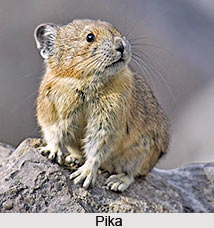
 Pika, also known as Rock Rabbit or Mouse Hare, resembles small guinea-pig or large hamster. The name "pika" is believed to be derived from the Tungus piika. The name `pika` is used for any member of the Ochotonidae. Pikas are quite unlike rabbit, their nearest relatives. They have a gentle, inquisitive nature and make fine pets.
Features of Pika
Pikas are about twenty centimetres long and adults weigh two hundred to three hundred grams. They are tailless and have mouse-like ears and hind feet. Upon close examination, however, they do have characteristics of the order Lagomorpha to which rabbits and hares belong; i.e. a second pair of upper incisors hidden behind the first pair, enamel on all sides of the incisors instead of only on the front as in rodents, lack of a baculum or penis bone, and many skeletal features typical of the order. Pikas have soft dense fur which is moulted twice a year. Under favourable conditions, Pikas can become very abundant. In some places, they are a pest. They can kill apple trees by removing the bark in the winter and damage wheat, potatoes, and garden greens in the summer.
 Species of Pika
All species of Pikas (genus Ochotona) are closely related and are difficult to distinguish from each other. The most recent studies indicate that there are about fourteen species; all found only in the mountains of Asia except one which has also spread to North America. Since they live in remote areas, most Pikas have been little studied. In the Indian region there are thought to be five species, only two of which, Ochotona rufescens in Baluchistan, Afghanistan and Iran; and Ochotona roylei in northern Pakistan, Kashmir, Nepal and northern Burma, are widespread.
Diet of Pika
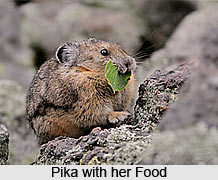
Most Pikas pile up large heaps of green vegetation which sustains them through the cold winter. These piles and the area around them are defended by a single animal which makes loud whistles to announce ownership. In the spring, territories are not defended and vocalizations are used to warn other Pikas of the approach of a predator. Ochotona rufescens is relatively silent.