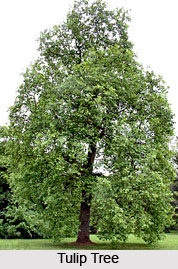
 Amongst the several species of `Spathodea`, the `Tulip Tree` is the most outstanding and also the most familiar. `Spathodea Campanulata` is the scientific name of the tree. The word `Spathodea` is a Greek word that means "spathe" and refers to the ladle-like shape of the calices and `Campanulata` describes the bell-shape of the flowers. It derived from the family of `Bignoniaceoae`. It has a lot of names in different languages. In Hindi, it is known as `Rugtoora` In English, it has four names. They are: the `Tulip Tree`, the `Scarlet Bell Tree`, the `Fountain Tree` and also the `Flame of the Forest`. The `Tulip Tree` was brought to India in the year 1873 from Africa and it is broadly cultivated at present. It can provide the people both the facilities of decoration and shade.
The `Tulip Tree` is very large in size and it sheds its flora at the end of its growing season in the dry places during the Summer. However, it never becomes bare in the other places. The major branches of the tree grow straight and because of the lateral branches being short; the tree is narrow and slim rather than spreading. This tree can reach the maximum height of 27 m. The bark is stringy and light grey in colour. The tree sheds its leaves in the month of February. In the months of March and April new leaves appear in abundance bearing some glorious clusters of orange and crimson flowers. The flowers assume on the ends of the branchlets. They also have some deep compact masses of dark olive-green colour and smooth buds, in up-turning curls. In the lower circle, the buds bend out and burst into fiery blossom with large wrinkled bells that are crimson and orange in colour. Four brown stamens rise from the centre. This time, the tree is glowing and dozens of ruby torches stand out in brilliant contrast to the deep green of the foliage.
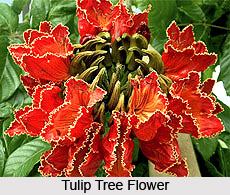 When the month of April ends, the flowers of the `Tulip Tree` fall down and during the rest of the year the unusual clusters appear for many times and the tree has quite a specific flowering period between the months of October and December. The leaves of the `Tulip Tree` are big and flat and mass towards the ends of the branches. They are made of from four to nine pairs of 5 cm in length leaflets and a terminal one. The leaves are oval-shaped and quite acutely veined. The tender leaves are feathery underneath. The pods look like the fingers of a hand that are pointing upwards and outwards above the foliage. Each of the smooth pods is some 15 or 20 cm in length and green and brown in colour. At the mature period, they crack and discharge white, papery, winged seeds. In Bombay, the `Tulip Tree`s not often bear fruits.
The name `Fountain Tree` initiated as the soft buds often contain a quantity of liquid and by squeezing them someone can make a jet like water squirt. The wood of the `Tulip Tree` is hard to bum and makes very poor firewoods. However, this wood is ideal to construct the sides of a blacksmith`s bellows.