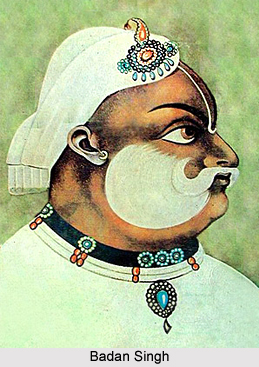
 Badan Singh was the nephew of Churaman, who was the first leader of the Jats and made them a political power in India. Though Churaman founded the Jat state but the Jat power was actually consolidated under the leadership of Badan Singh. He declined from the predatory way of life and aimed at transforming the Jat clan into an orderly principality with a regular government.
After the death of Churaman, conflict arose between Mohkam Singh, son of Churaman and Badan Singh but with help and assistance from Maharaja Jai Singh of Jaipur Badan Singh stepped into the seat vacated by his cousin Mohkam Singh. So far the Jats were a scattered race of peasants and thus the position of a recognised political chieftain was yet to be created among them. They had their own code of belief and refused to bow before anyone. But Badan Singh, with years of patient toil, matchless level-headedness and tactful administration, succeeded in showing seeds of happiness among his clansmen.
Badan Singh was a quite and polite man. He won over the grace of Maharaja Sawai Jai Singh, ruler of the Rajput state of Amber, and secured him as his protector. The Maharaja was obliged by the humble and submissive conduct of Badan Singh, which was quite unlike the rude and impolite nature of the Jats. Maharaja Sawai Jai Singh conferred upon Badan Singh the title of Braj-Raj or the lord of the holy land of Mathura so as to give him authority among the Jats at home and to entitle him to a greater respect abroad. But Badan Singh throughout his life represented himself in public as a mere vassal of the Raja of Jaipur. In a short span of time Badan Singh with his intellect and wisdom made himself master of the lands and goods of those who had till then been the chief men of his clan.
With the help of his able son Suraj Mai, Badan Singh was successful in subduing many Jat leaders including the Sogharia chief Khem Karan Singh from whom Suraj Mai conquered the Fatehpur fort (modern Bharatpur). Badan Singh established his kingdom in Bharatpur. Gradually and increasingly he established his domination over the area covering Mathura, Agra and part of Aligarh district. From the position of a zamindar he became a small Raja, strong enough to motivate awe among his neighbours. Badan Singh"s matrimonial alliances proved to be very beneficial for him and helped him to establish and enhance his authority. As he added more territory, he enlarged his army. People welcomed him because he meant to rule and not rob them. Badan Singh"s objective was to secure the title of Raja and he lived in a manner to deserve that title. He kept his court with adequate dignity. The Mohammedan officers, whom Badan Singh had taken in service, brought the required sparkle and dignity into his court and served there as models of court life and teachers of etiquette to his rough tribesmen.
Badan Singh was a great connoisseur of art and architecture and the immense expenditure on palaces, forts, parks, and cities indicated the great value of his treasures. He begun the construction of Deeg, and at Kumher he built many houses, harem palaces and a fort. At Kamar and Sahar also, he constructed mansions, temples, wells and gardens. At Wair in the Bayana district he laid out a large garden with a beautiful mansion called `Safed Mahal`.
Badan Singh died on 7th June 1756 at a ripe old age while he was spending a happy retirement at Sahar. The managements of his state were left in the hands of his most capable son, Suraj Mai. The credit for giving proper and legitimate shape to the Jat Kingdom has to be given to Badan Singh. Badan Singh outlined the Jat Kingdom and became its first Raja and this was his supreme achievement.