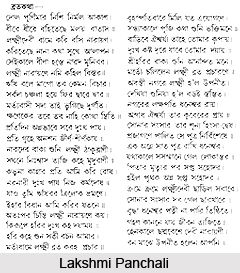
 The literal meaning of Panchali is `five-edged debate`. Panchali is a living Bengali tradition in the form of anecdotal narratives, extolling divinities in the classical Hindu pantheon as well as the more popular folk deities worshipped by different communities. It is usually recited in a sing-song manner with accompanying celebratory invocatory rituals, mainly in women`s quarters, its texts circulating in printed chapbooks used by devotees.
The Panchalis most widely read in Bengali homes include those glorifying the goddess Lakshmi and the folk deity Satya Pir or Satyanarayan. The more elitist and respectable Mangal-kavya i.e. propitiatory verse which constituted the mainstream of medieval Bengali literature, recited usually in payar or chaupadi metre, was also sung by groups led by a vocalist wearing bells on his ankles. This is playing the mandira i.e. finger cymbals in his right hand, and waving a chamar or whisk with his left as he filled out the narrative with songs accompanied by simple, dance-like movements. This can be considered a source, model, or even the more `cultured` variant of Panchali, which followed the same performatory style. While Mangal-kavya did not last long as performance but became part of the literary canon, Panchali survived on episodes or minor and subsidiary narratives drawn from them.
The performatory tradition allowed for different singers for different kinds of songs and for accompanists on the dhol and kansi i.e. bell-metal plate played with sticks. Panchali, in its adoration of holy men like Kalu Gazi i.e. a Muslim who gave protection from tigers or Satya Pir i.e. Satyanarayan, an old Hindu god, in a new incarnation, represents the free intermingling of Hindu and Muslim divinities that marked and manifested the cultural homogeneity in rural Bengali society up to the close of the eighteenth century.
It came into its own with Dasarathi Roy during 1806- 56. He was a singer-poet who used the semi-classical tappa style, conveyed a mix of literary flavour, religious feeling, and social concern, demystified and humanized the Hindu deities by exposing their vulnerability. It also drew them into contemporary space through recourse to topical allusions and earthy character types like Krishna`s gatekeeper. In the hands of his successors, Thakurdas Datta during 1801-76, Rasik Ray during 1820-92, and Brajamohan Ray during 1831-96, Panchali came closer to Kabigan before Rev. Kabigan is musical duels by two singing poets. James Long removed it beyond the culture of the bhadralok by describing it as `filthy and polluting`. For a while sung exclusively by women performers, it almost vanished at the close of the nineteenth century, to resurface later and survive marginally as part of subaltern culture.