 Prana is a Sanskrit word that refers to a life-sustaining force of living beings and vital energy in natural processes of the cosmic world. Prana was first explained in the Upanishad where it is part of the world ,sustaining the body and also the mind .Prana includes all the living form but it is not the atman or the individual soul .
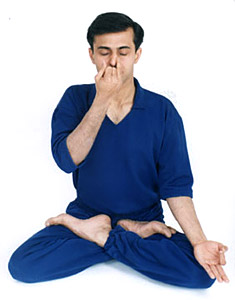
Prana is the main concept of the traditional Indian medicine and Yoga .It flows through fine channels called the the nadis ida, the pingala, and the sushumna. Ida is the left side of the body ending at the left nostril and pingala to the right side of the body ending at the right nostril. Within the body alternate nostril breathing balances the prana .When prana enters a period of intense activity, the Yogic tradition refers to it as Pranotthana.
Prana is also considered as a central concept in Ayurveda. Its subtle material form is the breath and its most concentrated form is semen in men and vaginal fluid in women. In Upanishads it is a part of the worldly, physical realm that sustains the body and the mother of thought. It fills all living forms but is not itself the individual soul. Sun and sunshine is considered as a source of Prana in Ayurveda.
Prana is held to be the Breath of life and in Yoga pranayama techniques are used to control the vital energies within the body.The presence of Prana distinguishes a dead body from a living one .When a person dies the prana or life force is thought to leave the body .All physical feelings and energies that arise or flow within the body is interpreted as prana .Infact feelings of hunger ,thirst ,heat ,cold are interpreted as pranic manifestation. There are five pranas or vital currents in the Hindu system. The pranas constitute the second sheath (kosa) of a human being (who is essentially the Atman or the Self).
Five Pranas
Prana is categorized into sub divisions which are also known as prana vayus.
Prana: Prana through breath enters the body thereby to every cell.
Apana : Apana is responsible for elimination of waste products from the body.
Udana : It is responsible for producing sounds through the verbal apparatus. It represents conscious energy that is required to produce the vocal sounds corresponding to the intention of the being.
Samana : It is responsible for digestion of food and cell metabolism. It also regulates the heat process of the body.
Vyana : It is responsible for expansion and contraction process of the body.
Five Upa-Pranas
The following are the five upa pranas
Naga : It is responsible for burping.
Kurma : It is responsible for blinking.
Devadatta : Devadatta is responsible for yawning.
Krikala : Krikala is responsible for Sneezing.
Dhananjaya : Dhananjaya is responsible for opening and closing of heart valves.