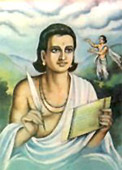
Kumarasambhava, Sanskrit Epic Poem - Informative & researched article on Kumarasambhava, Sanskrit Epic Poem
 Indianetzone: Largest Free Encyclopedia of India with thousand of articlesIndian Literature


in  
 Art & Culture|Entertainment|Health|Reference|Sports|Society|Travel
Forum  | Free E-magazine  | RSS Feeds  
Indian Literature : Indian Literature |History of Indian Literature |Sanskrit Literature |Indian English Literature |Regional Indian Literature |Indian Comics |Indian Poetry |Indian Literary Personalities |Indian Epic Poetry |Renaissance in Indian Literature |Indian Novels |Indian Literary Organisations |Indian Literary Movements |Contemporary Indian Literature |Medieval Indian Literature |Ancient Indian Literature |Themes In Indian Literature |Genres in Indian Literature |Influencing Factors On Indian Literature |Forms of Indian Literature |Religious Influence on Indian Literature |Modern Indian Literature |Vedas
Home > Reference > Indian Literature > Sanskrit Literature > Kumarasambhava
Kumarasambhava, Sanskrit Epic Poem
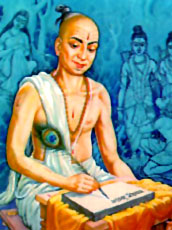
Kumarasambhava is one of the greatest epic poems written by the famous poet Kalidasa.

 Kumarasambhava, Sanskrit Epic PoemKumarasambhava or Kumaarasambhavam is one of the Sanskrit epic poems written by Kalidasa. Kumarasambhava means the birth of the War God or Kartikeya, Lord Shiva`s first son.

The epic poem Kumarasambhava is divided into seventeen chapters or sargas. They describe the courtship of Lord Shiva and Devi Parvati. The seventeen chapters are said to be Shringar Rasa that is the illustration of love, romance, and sexual desire. It is said that a powerful rakshasa or demon named Tarakasur was blessed that he would be killed by Lord Shiva`s son. However, Shiva had condensed the desire for love by intense meditation. Parvati performed great tapasya or spiritual penance and won the love of Lord Shiva. Later Parvati gave birth to a son named Kartikeya. Kartikeya grew up and killed Tarakasur and restored tranquility and the glory of Lord Indra and the celestial world. This how ends the story of Kumarasambhava.

There is a mythical story relating to Kalidasa when he was writing Kumarasambhava. Kalidasa abandoned his home and went away in search of knowledge and become worthy of his intellectual wife Vidyotama. When he returned his wife asked, `asti kashchit wagvisheshah` that means if he had attained any intellect which should prompt her to extend a special welcome to him. Kalidasa wittily gave an appropriate answer to this. He informed Vidyotama that he had created three great epics based on the three letters uttered by his wife, `asti`, `kumarsambhava` and `kashchi`. The three words relates to the three great epics, Kumarasambhava, Meghadutta and Raghuvansa.

It is believed that Kalidasa was cursed with leprosy when he completed the eighth chapter of Kumarasambhava. In this chapter he described the act of love between Lord Shiva and Parvati. The last part of Kumarasambhava was completed by an anonymous writer.
(Last Updated on : 26/09/2009)
 
 
Contribution of South India to Sanskrit Kumarasambhava Sanskrit Literature During the Gupta Age
Titles of Honour in Sanskrit Proficiency Tulsidas Kalidasa
Anala Narayana Bhattatiri Rajasekhara
Dhvani Mallinatha Bharavi
Mattavilasa Prahasana Appaya Dikshita Ananda Giri
Fairy tales and fables in Sanskrit Literature Classical Poetry in Sanskrit Literature Scholarly treatises in Sanskrit Literature
Panini Bhatti Kavya Bhartrihari
Gadyakarnamrita Jayadeva Geeta Gobinda
Kalhana Kathasaritsagara Harisena
Vatsabhatti Raghuvanga Bharavi
Bhatti Kumaradasa Magha
Asvaghosha Shishupala Vadha Amaru
Sanskrit Secular Poetry Sanskrit Religious Poetry Sanskrit Anthologies
Sanskrit Gnomic Poetry Sanskrit Didactic Poetry Origin of Fable in Sanskrit
Historical Kavya in Sanskrit Literature Banabhatta Brihatkatha
Dandin Subandhu Vasavadatta
Somadeva Development of Sanskrit Literature Brihatkathmanjari
Sanskrit Scientific Literature Origin of Sanskrit Lexicography Features of Sanskrit Literature
School of Early Poetics Visakhadatta Sudraka
Recently Updated Articles in Indian Literature
Romuald D`Souza
Romuald D`Souza is the founder of Goa Institute of Management who holds a place of eminence amongst the Indian scenario due to his contribution to Indian education.
Irwin Allan Sealy
Irwin Allan Sealy is one of the underrated writers of Indian subcontinent who has created a niche for himself by his pinching eye for detail and inclusion of Indianness amidst the length and breadth of Indian writing in English.
Contribution of Sreemanta Shankaradeva to Ankiya Nats
Contribution of Sreemanta Shankaradeva to Ankiya Nats depicts the thresholds of Assamese dramaturgy.
Bimal Mitra
Bimal Mitra is one of the exponential writers of Bengali literature whose contribution to literature has surpassed the stereotypical borders of black and white literature as well as round and fixed characters.
Kamalakanta Bhattacharjya
Kamalakanta Bhattacharya was a poet who belonged to the Oronodoi age who succeeded in revolutionizing poetic diction.
E-mail this Article | Post a Comment
Forum
Forum on Indian Literature
Free E-magazine
Subscribe to Free E-Magazine on Reference
 
 
Kumarasambhava, Sanskrit Epic Poem - Informative & researched article on Kumarasambhava, Sanskrit Epic Poem
Sitemap
Contact Us   |   RSS Feeds
Copyright © 2008 Jupiter Infomedia Ltd. All rights reserved including the right to reproduce the contents in whole or in part in any form or medium without the express written permission of
Jupiter Infomedia Ltd.