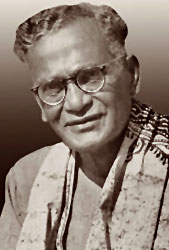
 Nandalal Bose (December 3,1883,Kharagpur, Bihar-April 16,1966. Calcutta) was considered as the best painter of modern Indian Art by many of the art critics. His life and work was influenced by Tagore family, specially his mentor Abanindranath Tagore and his paintings was based on Indian mythology, art in Ajanta caves and village life. He was selected as the principal of Kalabhavan (Art Department) at Shantiniketan and was awarded with `Padmavibhusana` by Indian Government on 1954.
Nandalal was born in Kharagpur in Monghyr district of Bihar province on December 3,1883. His father Purnachandra Bose was the manager of the Kharagpur Tahsil of the Raja of Darbhanga. His mother Kshetramoni Devi though died at his eight years of age had strong influence on him all throughout his life. At the age of fifteen Nandalal Bose came to Calcutta to continue his study and was admitted to Central Collegiate School from where he passed the Entrance examination. Then he enrolled in General Assembly College but his heart was in art and he spent all his time in collecting books and magazines of art. He failed to pass F.A.Exmination and joined Metropolitan College but failed again. Nothing could reduce his interest in art and he tried continuously to learn painting. From his cousin Atul Mitra Nandalal learned model drawings, still life and sauce painting. He also copied the paintings of European masters like the Raphael`s `Madonna` and many more. Nandalal had also interests about Raja Ravi Varma`s paintings and his independent work `Mahasveta` had a clear influence of Ravi Verma`s style. At the age of 20 Nandalal Bose got married to Sudhira Devi and his father in law Prakashchandra Pal insisted him on joining Presidency College. But here also Nandalal could not concentrate on studies because of his increasing passions for art and paintings.
Nandalal was overwhelmed by the paintings of Abanindranath Tagore like `Budhha` and `Sujata`,`Bajramukut` etc and he recognized his guru. But he was too shy to approach Abanindranath and his friend Satyen took the responsibility on his behalf. Nandalal went with few of his paintings to Government Art College and his works were appreciated for the boldness, maturity and innovativeness of lines and subject. `Mahasveta` won over Havell while `Ganesha` took Lala IshwariPrasad`s admiration. Nandalal started his lessons under Harinarayan Basu and Iswariprasad`s guidance but later he was the only disciple of Abindranath for five years. Abanindranath helped Nandalal to grow from a sapling to a tree by his unusual way of teachings. That time Bose was awarded with twelve rupees monthly stipend. Abanindranath used to tell the story of Ramayana, Mahabharata and other Hindu mythologies in classes as well as arouse his students` imagination through recitation and discussion so that they could have the essence of both classical and folk style of Indian Art. In this period few of the Bose`s work along with `Sati` was extremely appraised by the artists and art critics like Gagenendranath Tagore, Anand KumarSwami and O.C.Ganguli. He also got immense encourage from Sister Nivedita who later became a great friend of him.
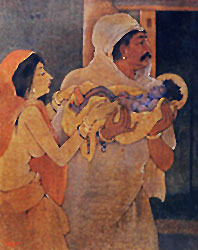 Along with being a great painter, Nandalal Bose played a leading role in the renaissance of art in India with his co painters namely Asit Kumar Halder, Surendranath Ganguli, Samarendra Gupta, Kshitindranath Majumdar, Surendranath Kar, K. Venkatappa, Hakim Mohammed Khan, Shailendranath Dey, Durga Simha etc, who were all influenced and inspired by Abanindranath Tagore. `Art for people`s sake` was Nandalal`s motto and once to fulfill his principal he went to Banupur and sold his drawings in 25 paisa each. He wanted that common people could hang paintings on their wall. When Abanindranath heard about this eccentricity he went to Banupur and bought all the pictures. When Indian Society for Oriental Art was founded Nandalal Bose was awarded a prize of Rs. 500 in the first exhibition. Bose declined the offer of joining Government Art College and instead remained busy in helping Ababnindranath to prepare a catalog of the art collection in his home.
Rabindranath Tagore was very fond of Nandalal Bose. He appointed Nandalal as the Principal of Kalabhavan and was very happy about that. He said about Nandalal " Rarely did one come across in one person such a union of intelligence, sympathy, skill, experience and insight ". He honoured Nandalal with a welcome song at Kalabhavan. Nandalal illustrated several works of Tagore like `Chayanika`,`Crescent Moon`,`Gitanjali`,`The Fruit Gathering` etc. Rabindranath also wrote a poem about one of the Nandalal`s painting called `Diksha`. Tagore depended upon Nandalal for the stage settings of his plays. In 1924 Bose traveled with Tagore in China, Japan, Malaya and Burma and in 1934 they visited Ceylon (Srilanka) together. Once Nandalal Bose spent one month in Rabindranath Tagore`s estate to work on the beautiful scenery of river Padma.
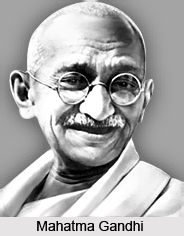
Gandhiji and Nandalal were great friends. A painting of Nandalal Bose is still hanging on the wall of Gandhiji`s ashrama in Sevagram, which depicts Buddha carrying a lamb that was saved by him from being sacrificed in Bimbisara`s yajna.
Nandalal used to use a variety of subjects and material, especially subjects chosen from Ramayana, Mahabharata, Hindu mythologies, Budhhist Jataka and life of Lord Budhha and also from nature and human life. His paintings were of various sizes. For material he used different kind of papers, cotton and silk canvasses. Nandalal also used variety of colors and sometimes instead of brush he used rags. His paintings were highly appraised by artists, art critics as well as his mentors. When Abanindranath Tagore saw Nandal`s `Swayamvara of Damayanthi` he remarked, "I can smell the sweet scent wafted from the marriage manatpa."(A mantapa is a special structure for an auspicious occasion. The great Japanese artist Okakura commented on Bose`s painting `Agni`(Fire) that "It has everything but the only thing it lacked was fire."
Sister Nivedita persuaded Nandalal Bose to make copies of the Ajantha frescoes. (Ajantha is a village in Maharastra where there are numerous caves with great paintings on their walls and ceilings). Nandalal, Venkatappa, Halder and Samarendra Gupta made a team to work there. Nandalal copied the Bagh Caves in Gwalior. He also wanted to copy the frescoes of Sarnath but was not allowed since he was not a Budhhist. Thus Nandalal rediscovered the ancient Indian spirit of art.
In the Basu Vijnana Mandir and Cheena Bhavan of Calcutta Nandalal painted murals. He was also invited by the Maharaja of Baroda to do the fresco work.
Nandalal Bose was honored in all the ways an artist can have. He was awarded a silver medal in Allahabad Painting Exhibition and gold medal in Lucknow Exhibition. He was elected as fellow of The Lalit Kala Academy of India. Several universities conferred Honorary Doctorate on Nandalal Bose. Visva Bharati University honoured him with `Deshikottama` title. Bose designed the emblems of highest awards like `Padmashri`, `Padmabhushana`, `Bharatha Ratna` on request of then Prime Minister of India Jawaharlal Nehru. In 1954, Nandalal Bose was given the award `Padmavibhushana` by the Indian Government. The Academy of Fine Arts in Calcutta honored him with the Silver Jubilee Medal. In 1965 The Asiatic Society of Bengal awarded Bose with the Tagore Birth Centenary Medal.
This genius artist died on April 16,1966 at the age of 83.