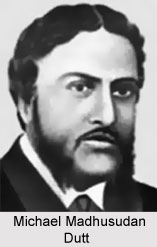
 Michael Madhusudan Dutt, also known as Michael Madhusudan Dutta was a renowned Bengali dramatist and poet from the 19th century. His popular Bengali literary work titled Meghnad Bodh Kavya is considered as a tragic epic. Dutt was a pioneer of Bengali drama. The work of Bengali literature consists of 9 cantos and the content and style of composition is exceptional. The author also composed numerous poems regarding the sufferings and sorrows related to love, as expressed by women. Michael Madhusudan Dutt, from a young age, desired to be like an Englishman in manner or form. He later converted to Christianity at an early age and adopted the name Michael. Although in his later life, the Bengali poet regretted his fascination towards the English and the Occident. He passionately wrote about his motherland in his poetic compositions and sonnets that were written during this time.
Michael Madhusudan Dutt is considered as one of the greatest authors and poets in Bengali literature. He is also regarded as the father of the Bengali sonnet and also pioneered the blank verse known as Amitrakshar Chhanda. He died on 29th June 1873 in Calcutta (now Kolkata).
Early Life of Michael Madhusudan Dutt
Michael Madhusudan Dutt was born on 25th January 1824 in a Hindu upper class family, in Sagordari village in Keshobpur Upozila on the bank of River Kopotaksho, located in the district of Jessore, East Bengal. Rajnarayan Dutt, his father was a well known author and Jahnabi Devi was his mother. He was deeply influenced by English literature in his childhood and started learning English literature in his home. He also learnt Persian at an old mosque and was a remarkably talented student. All his teachers and professors praised him as intelligent child who was skilled in literary expression. Michael Madhusudan Dutt received his initial education in English and European literature from his home and later imitated the British in intellect and manners.
He took admission in the Hindu college as a student of English literature. At that time he was deeply moved by the poem of famous English poets like Thomas Moore, John Keats and George Byron and others and started writing English poems. These poems were published regularly in the Bengal Spectator, Literary Gleaner, Calcutta Literary Gazette, Literary Blossom and Comet due to his excellent command over English literature. Later Dutt got admitted to Bishop`s College where he learned Greek, Latin and Hebrew languages.
Most of his early poetic and dramatic works were composed in English. Some of these works include poems namely Captive Ladie; plays such as Ratnavali, Sormistha; and translations like Neel Durpan.
Career of Michael Madhusudan Dutt
In 1848 Michael Madhusudan Dutt went to Madras and took the job of an English Teacher at the Madras Male Orphan Assylum School. In 1852 he joined as an English teacher at the Madras University School section. There he also started working as a journalist. He was in the editorial staff of Madras newspapers such as the Madras Circulator and General Chronicle, Aethenium and the Daily Spectator. He became the joint-editor of the Spectator and later the Chief Editor of the Hindu Chronicle.
Literary Works of Michael Madhusudan Dutt
The first anthology of English poetry of the eminent Bengali poet, including The Captive Ladie and Visions of the Past, were published in the year 1849. Although the literary works were well acknowledged English educated populace, but the publications were not able to achieve success. After the death of his mother in 1853 and his father in the year 1855, Michael Madhusudan Dutt went into depression.
In 1956, he came back to Calcutta (now Kolkata) and he took job as Head Clerk of the Police Court where in the next year he worked as an interpreter during the Sepoy Mutiny 1857. Later, he was inspired by his friends to commence his literary career in his mother tongue. Dutt started translating English dramas into Bengali but he was not satisfied with that .He wanted to write new plays in Bengali. He wrote three new Bengali plays- Sermistha, Kissen Cumari and Maya Kanan in this time. He also penned a few sarcastic writings like- Ekei ki Boley Savyata, Booro Shaliker Gharhey Ro. He translated the famous Bengali work Neel Durpan in to English as well. The work entitled Meghnadh Badh Kabya is another popular work written by Michael Madhusudan Dutt and is considered as a heroic and tragic epic in Bengali. After the publication of this work, he established himself as a renowned Bengali author and poet of a new genre of poetry.
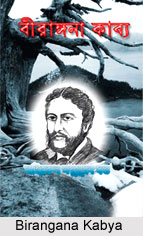
The most significant period of his literary career came when he started writing Bengali poetry in new style. He broke the old poetic traditions and introduced sonnet as well as the unconventional blank verse style in Bengali poetry. In the year 1860, his poetry in blank verse Tilottoma Sambhav Kavya startled the literary circle of Calcutta. He gave completely a new dimension of epic Ramayana and wrote his famous epic poetry Meghnad Badh Kavya. It astonished the reader. This was followed by Brajangana Kavya,and Veerangana Kavya. The literary work of Mayakanan (1873) was the last composition of the Bengali writer.
Later Life of Michael Madhusudan Dutt
At a later period, Michael Madhusudan Dutt went to London to attain a degree in law. Due to deep financial crisis there he wrote some sonnets to earn money. He was also financially supported by Ishwar Chandra Vidyasagar to help him pass the Law course. After he came back to Calcutta in 1867, he started practicing at Calcutta High Court. Later he became the Examiner of the Privy Council at the High Court. At that time he translated the great epic of Homar- Ilied.
Personal Life of Michael Madhusudan Dutt
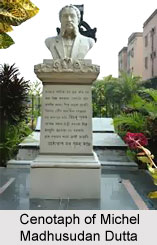 Michael Madhusudan Dutt was married to Rebecca Mactavys when he resided to Madras (now Chennai). The couple had four children. The marriage later ended in a divorce. After he returned to Calcutta from Madras in February 1856, Dutt got married to Henrietta Sophia White. The couple stayed together till his death and had a daughter named Sharmistha and a son named Napoleon. Leander Paes, a popular Indian tennis player, is the son of the great-granddaughter of the Bengali poet.
Michael Madhusudan Dutt died on 27th June 1873, Sunday, after suffering from prolonged illness. He died in the Calcutta General Hospital, three days of the death of his wife Henrietta.
The popular Bengali author is considered as the father of Bengali sonnet and one of the greatest poets in Bengali literature. He pioneered the concept of blank verse, known as Amitrakhor Chhondo in Bengali poetry. He also wrote poems about the sorrows and suffering of love as spoken by women.