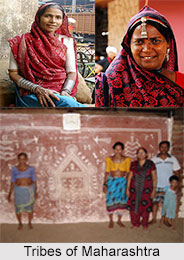
 Kunbi tribe is largely found in the states of Gujarat and Maharashtra. Kunbi is also known as Kudumbi. Further, in the central provinces of the country, they actually form the major cultivating class. The etymological meaning of the term Kunbi is a farmer. The main occupation of the Kunbi people is agriculture but nowadays many of these Kunbi tribes have adapted to professions of workers in the fields. Kunbi tribes are mainly familiar as the community of traditional farmers who are found in the provinces of central and western India. The language used by the Kunbi tribe is Konkani language.
It is believed that Kunbi people entered the province of Khandesh from Gujarat as they were forced by the Rajput tribes to leave the region. From there they probably spread into the adjoining Wardha, Nagpur and Berar districts. Later during the rule of Gond tribe, administration of Deshpandia and Deshmukh existed. Deshmukhs were considered as leading Kunbis and Deshpandia were head accountants or Patwari. These two titles of the Kunbis are still borne by many families in the western provinces. The internal caste structure of Kunbi community in the central region reflects that it is basically a mixed occupational community. Jungly or Jhare Kunbis are the oldest immigrants. Another primitive group of Kunbi community is the Manwa Kunbi. Other sub-castes of Kunbi community are the Khaire, Dhanoje and Tirole. In the central provinces, Tirole is considered as the highest sub-caste, who claims their origin from the Rajputs. It is also said that Deshmukhs were members of the Tirole sub-caste. In their society, widow remarriage is not allowed. Wandhekars are another sub-caste that also includes some Deshmukhs. Wanjari sub-caste is a large group and they represent a branch of Banjara caste. Lonhare, Ghatole and Baone are other important sub-castes. Moreover, in the central provinces Gujrati Kunbis are also found.
Each of the sub caste of Kunbi community has various exogamous clans. Some of these clans are named after animals or certain villages. The major clans or septs of Tirole sub-caste are Kole, Wankhede, Kadu, Kadam, Jagthap, Lohekari, Meghe, Shinde, Ughde, Kalamkar and Sutar. Baone sub-caste has clans namely Dokarmare, Titarmare, Lute, Kantode, Patre, Naktode, Bagmare, Burud and others. A man is not permitted to get married within his own clan or kul. Union between first and second cousins is also forbidden. Girls in Kunbi community get married within the age of five and eleven and boys get married between ten years to twenty years. Polygamy is allowed in their community however it is least practiced. Divorce and widow re-marriage is also allowed in Kunbi community. Kunbi people either burn or bury the dead.
The societal structure of the whole of the Kunbi tribal community is still backward. There are only hardly any instances found where one can find someone who have opted for education and also become affluent. In the past few years, many efforts have been taken to ameliorate their social and economic status. In the past, it appears from records that Kunbi community has been synonymous with cultivators. Their customs and traditions signify some primitive cultures of Indian societies. The culture and tradition of the Kunbi community is quite enriched. The famous saint of Maharashtra, Sant Tukaram belongs to the Kunbi community.
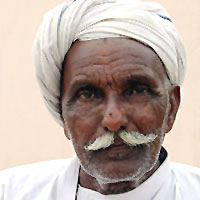
By nature these Kunbi tribes are quite hard working and simple. The Kunbi people have got orientation towards religion and have also got spiritual bent of mind. Kunbi men are normally of dark complexion, having a strong body structure with elongated cheekbones. They also grow their beards pretty long. As far as the physical appearance of these Kunbi people is concerned, they resemble to any of the native tribes of the Indian subcontinent. However, their physical appearances have gone changes due to climatic and geomorphologic influences.
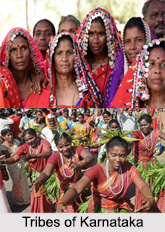
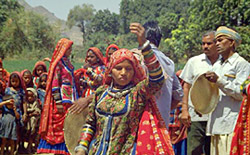
Cultural exuberances of the Kunbi community are depicted striking in various aspects like dressing, rites, customs etc. They wear dresses which are simple, yet, quite exquisite. Aged people of the community choose white dhoti and shirt. Old Kunbi women have the tradition of wearing the sari which is quite similar to any outfits of the tribes. This sari is also known as `Guzli`. Now a days though this sari was not in fashion any more, all the elderly Kunbi tribes try their level best to stick to their tradition .The conventional cuisine of these Kunbi tribes is better known as Gessi which are specially served as delicacies at the time of social functions and affairs. Patravado is also a delicacy prepared with lots of leafy vegetables. Most obviously, the nutrients values are not only quite high, it is also very good to taste.
The costumes of the Kunbi tribe are impressive and have a distinct style and approach. The women of this tribal community prefer to wear heavy ornaments and but in recent times, they wear light ornaments instead of the heavy ones. The women of the Kunbi tribes wear Dhorlu pendant, Teak Nath, Chudi or bangles, Mangal Sutra, Kundala earrings, Jhanhar anklets, Jhoduva silver toe rings and necklaces. The brides of the Kunbi tribes wear a saree in the Maharashtrian style, Choli along with the different ornaments. Another popular leafy item is the Patravado which is highly nutritious and tasty and is preferred among the Kunbi tribal people. Dishes prepared from Avil or beaten rice is another well-liked cuisine of the Kunbi community. The popular legend is that even the Maharaja of Travancore was so much pleased to taste this item that he immediately ordered near about forty Kunbi families to prepare food for him.
The Kunbi people are religious minded and god-fearing people; this fact is highlighted in various customs and norm that they follow through out the year. Majority of the Kunbi people revere the Mother Goddess. She is also popular as Sakti or Devi, and till date these Kunbi tribes have retained this age-old tradition and convention. The Kunbi females held special worship which is popularly acclaimed as Suvasini or the Suhasini Puja. Festivals and fairs are part and parcel of this Kunbi community. This tribal community considers Shapta Sungi Mataji as an important Goddess. They also worship the Hindu gods and goddesses like Lord Ganesha, Lord Hanuman, Lord Shiva and Parvati, Lord Krishna and Lord Vishnu.
The major festival of the Kunbi tribal community is Pola. Although the Kunbi community celebrate almost all the festivals of national importance, they have incorporated some of special customs to them. These include Holi, Onam, Vishu, Navaratri, Shivaratri, Nagapanchami etc. Apart from celebrating these festivals they also celebrate Dangs durbar, Holi and Waghdev Barasa Puja. They celebrate their main festivals with their tribal dances and songs. They use several musical instruments like Basuri, Dholak, Pavri, two small drums called Sambre and Banjo. Kunbi people have the conservative instincts and patience similar to that of typical agriculturalists.