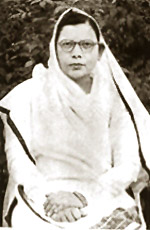
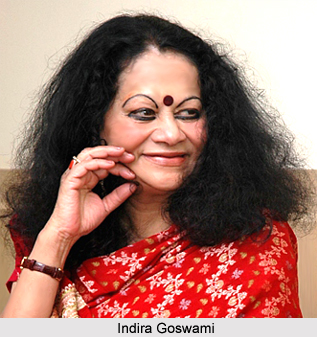
 Indira Goswami is indeed the name, the identity that banks of Bramhaputra have sprouted on 14th November, 1942 in Assam. Soft-spoken as she has been throughout, her articulation almost sing-song, bird-like, a marked difference reflecting her bold works.
Early Life of Indira Goswami
Indira Goswami was born at Amranga Xotro (one of many religious centres established by the Assamese saint Sri Sri Xonkordev in the 15th century) in a priestly Brahmin family. Her father`s name was Umakanta Goswami. She is popularly known as Mamoni Raisom Goswami or Mamoni Baideo in Assam. The pillars of her initial education were planted at Pine Mount School in Shillong, Meghalaya, where English served the medium for instruction. But soon after she came back to Guwahati and joined Tarini Charan Girls Higher Secondary School. Later, at Cotton College under the able tutelage of Professor Upen Lekharu, she entered the rich, passionate world of Assamese literature and language, earning her bachelor`s degree in 1960. She went on to complete her masters in Assamese from Gauhati University (1963) and then a doctorate (1973). Finally, she joined the Department of Modern Indian Languages at the University of Delhi, where she taught Assamese until her retirement.
It was from childhood that she had a flair for writing. In 1962 her first anthology of Short Stories Chinaki Morom was published when she was in college. At that time she was greatly inspired by famous Assamase writer Kirti Nath Hazarika who published her first collection of short stories. Indira Goswami wrote about 100 short stories during this time but most of these were lost due to the lack of proper conservation.
Personal life of Indira Goswami
Her life seems to be replete with an aura of never ending tragedies. From her early age she suffered from mental dejection. Several times she attempted to jump into the Crinoline waterfall, which is located near her house in Shillong. She mentioned it in her autobiography named The Unfinished Autobiography, which was later translated in English by Prafulla Kataki. If compassion came unsurprisingly to this precociously perceptive mind, tragedy too ignited the spark of the ongoing turbulence leading to what one calls the pain leading to creation. She got a serious mental shock after her father`s death. Her first marriage, in 1965, to an Assamese, a marine engineer who belonged to the Ahom community, ended in the same year on the grounds of caste differences. Again she was mentally broken when her husband Madhaven Raisom Ayengar died in a car accident in Kashmir after eighteen months of their marriage. After that she returned Assam and started teaching at Goalpara Sainik School. At that time she started writing again to avoid loneliness of her life. In this time she wrote two novels. These are Ahiron and Chenabor Srota. She shared her own experiences with her husband in Madhya Pradesh and Kashmir in these two books.
 After that she was convinced by her teacher Upendra Chandra Lekharu to go to Vrindavan for research. She left the job of Goalpara Sainik School and went to Vrindavan. There she did extensive research on Radheswamis of Vrindavan .( In Vrindavan the widows of Hindu religion gathered and collected money from pilgrims to live hand to mouth and saved some money for their holy cremation after death. But in most cases their money were snatched and their dead bodies did not get proper creamation.)In her book The Blue Necked Braja, Indira Goswami successfully highlighted their plight and hardships of life. She earned many critical accolades and it created a mark in Indian literature. It was the first book in this subject.
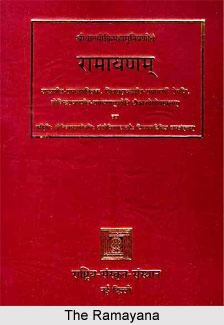
After that she researched on Ramayana studies. She selected two great books for her research work. One is the huge volume Tulsidas`s Ramayana and another is the 11th century Assamese Ramayana of Sri Madhava Kandali named Ramayana from Ganga to Brahmaputra. She won many laurels for this research. From that time she has been teaching Assamese literature at University of Delhi till now.
Works of Indira Goswami
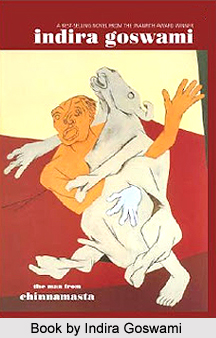
She wrote many novels along with teaching. Her most famous novels are The Pages Stained With Blood, The Moth Eaten Howdah of a Tusker, Dasharathir Khoj and The Man from Chinnamasta. The Pages Stained With Blood based on the plight of Sikhs in the Anti-Sikh riots of 1984 after the assassination of Prime Minister Indira Gandhi. He told her own experiences in this book. The Moth Eaten Howdah of a Tusker is about the plight of Assamese Brahmin widows in the religious institutions of Assam called Satra. This novel was selected for the book, The Masterpieces of Indian Literature. In more than hundred years since the first Assamese novel ( Miri Jiyori in 1890 by Rajani Kanta Bordoloi) was written, no other writer in Assam had the kind of iconic aura to his/her persona as Mamoni baideo had, an aura that combined a great depth of feeling with an equally great depth of thought. Perhaps it lay in her refusal to be cloistered within the four walls of academe; perhaps it had to do with her intense and instinctive concern for the downtrodden, the fallen and the outcast; or perhaps, possessed as she was by an undercurrent of melancholy, creativity came as the foil she required to sustain her own life force. Although she describes a harsh reality, her work is extremely poetic and soft. "You have to be poetic because the subject is so hard and rough. You must protect your subject like a mother protects her children. My stories are based on harsh reality, but I transform it. I turn it into literature; otherwise it would simply be a pamphlet. You must be an artist to do that, a great artist, or people will not read it."
In the book The Man from Chinnamasta she protested against traditional custom of animal sacrifice of Hindu religion in the Kamakhya temple. She was even threatened for death from the Hindu religious community. This novel has been translated into English by Prasanta Goswami. In 1996 "The Moth Eaten Howdah of a Tusker" was made into an Assamese film named Adajya directed by Swantana Bordoloi starring Tom Alter and Nandita Das. Adajya won international awards in Various Film Festival. This film was also shown in television in two series. Films like-Aparajita by Kuntala Sharma and Words from the Mist by Jahnu Barua were made on her life. She has been working as an arbitrator between banned ULFA militants of Assam and Government of India.
Awards received by Indira Goswami
Indira Goswami was awarded the highest literary award Jnanpith Award in 2000 for her works about marginalised and subaltern people. She received Sahitya Akademi Award in 1983 and Padma Shri in 2002. She has received many other awards like the Assam Sahitya Sabha Award, 1988; Bharat Nirman Award, 1989; Sauhardya Award, 1992; Katha Award, 1993; Kamal Kumari Foundation Award, 1996.
Indira Goswami, the cultural ambassador of Assam, breathed her last on November, 2011 at the age of 70.