


 Indian Oil Painting is the expression of the thoughts, consciousness and imagination of Indian artists in oil colours and lines. The execution and themes are numerous and thus vary as per the sensibilities and style of the artists. From inspirational or religious to abstract and secular; the themes and images of Indian oil paintings display a great variety. The art of oil painting, which was innovated in ancient Greece, was brought to India by the European colonizers. Indian Oil Painting is the expression of the thoughts, consciousness and imagination of Indian artists in oil colours and lines. The execution and themes are numerous and thus vary as per the sensibilities and style of the artists. From inspirational or religious to abstract and secular; the themes and images of Indian oil paintings display a great variety. The art of oil painting, which was innovated in ancient Greece, was brought to India by the European colonizers.
The magic of Indian oil paintings are definitely remarkable. Humble pigments mix with linseed oil creates poetry on canvas but the process of oil painting is not that magical. It involves sweat, toil and incredible perseverance of the painter. History of Indian Oil Painting Traditional oil painting techniques commence with the artist sketching the figure onto the canvas with charcoal. When Renaissance oil painting techniques were used in Indian oil paintings, it had nearly fully restored in popular tempera paintings. The history of oil paint was traced to western Afghanistan sometime between the 5th and 9th Centuries and it gained popularity during the 15th century. Oil paint is then mixed with turpentine, linseed oil, artist grade mineral spirits or other solvents to create a thinner and faster drying paint. Themes of Indian Oil Painting The God and goddesses, animal figures, court scenes, romance, nature, mythology, literature, folk lore and everything in life and imagination are the subject for a painting. Though, there are a number of painting themes which have tempted the artists and admirers for ages. Oil Paintings of Flowers: Oil Paintings of Flowers are an attempt to capture the splendour of flowers. Different painters have effectively managed to convey emotions throughout their Oil Paintings of flowers. Landscape Oil Painting: Emotional landscape oil paintings portray the enormity of the world infusing life on the canvas with each stroke of the painting brush. 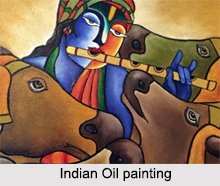 Oil Portrait Paintings: Oil Portrait Paintings are one of the most exciting pieces of art. The artistic significance in these paintings shows the look of the person and captures some classic characteristic of that very person. Oil Portrait Paintings: Oil Portrait Paintings are one of the most exciting pieces of art. The artistic significance in these paintings shows the look of the person and captures some classic characteristic of that very person.
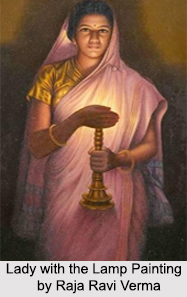
Use of Oil in Paintings Painting by using oil is the process of painting with pigments which are mixed with a medium of drying oil or the linseed oil, available in early modern Europe. Often this linseed oil was boiled with a resin such as pine resin or even frankincense; these were called 'varnishes' and were valued for their body and gloss. Other oils occasionally used in Indian oil paintings include poppy seed oil, walnut oil, and sunflower oil. Oils provide several properties to the paint like less yellowing or varied drying times. Different oils are often being used by oil painters in a particular painting depending on certain pigments and the desired effects. A number of oil paintings display proof of scraping if closely examined, mainly after examining the surface. Oil paint often dries by oxidation, not evaporation, and is usually dry to the touch in a day to two weeks and is usually dry enough to be varnished in six months to a year. The linseed oil of the oil painting itself comes from the flax seed and this flax was a common fibre crop. Small alterations in the molecular structure of the oil create this water miscible property. A still-newer type of paint, heat-set oils, remains liquid until heated to 265 to 280 degrees Fahrenheit for about fifteen minutes. Traditional artists' canvas for oil paintings are made from linen, but the less expensive cotton fabrics has gained popularity. Creation of Indian Oil Painting First, the artist makes a wooden frame known as strainer or stretcher. Then over a wooden from a canvas is pulled across and the same is stapled or tacked tightly at the back edge. The next step is for the artist to apply a 'size' to separate the canvas from the acidic qualities of the paint. Traditionally, the canvas was covered with a layer of animal glue (size) and primed with lead white paint, sometimes with added chalk. Panels were prepared with a gesso, a mixture of glue and chalk that is frequently used on canvas, whereas real gesso is not suitable for that application. Indian Oil Painting Brushes The brushes for oil painting are made from a variety of fibres to create different effects. Fitch hair and mongoose hairbrushes are very fine and smooth, and thus cater well to portraits and detail work. The finest brushes are known as kolinsky sable. The fibres of this brush are collected a Siberian mink's tail. This hair keeps a superfine point, has smooth handling; this is known to artists as a brush's 'snap'. Different types of unconventional tools including sponges, rags and cotton swabs, can also be used. There are also several artists who paint by using their fingers only. When the image is finished and dried for up to a year, the artist seals the work with a layer of varnish typically made from dammar gum crystals dissolved in turpentine. Present-day artists largely resist the varnishing of their paintings, opting to keep their works varnish-free indefinitely. Like in the rest of India, oil painting is immensely popular in Kerala. Famous Indian Painters Born in the year 1843, at the Kilimanoor Palace, 25 kilometres from Thiruvananthapuram, Raja Ravi Verma was one of the greatest artists in the world of Indian Oil Art. He won the first prize in Vienna Art Exhibition in the year 1873, and won international acclaim. The themes of Ravi Verma's paintings were scenes from the Indian epics which include the Ramayana and the Mahabharata or stills from the myths and legends of India such as the tale of King Nala and Damayanti. His popular themes related to women are brought out best at his masterpiece painting Lady with the Lamp. George Oommen is one of the contemporary Indian oil painters of international acclaim. Anu Prem, Bikash Bhattacharjee, Amrita Shergil are some of the famous Indian painter. |
| |||



Indian Oil Painting
| Indian oil painting expresses the consciousness, thoughts and imagination of Indian artists. The oil paintings of India deal with themes including the great epics, myths and legends, etc and thus possessing a great variety. |
| ||||||||||||||||||||||||||||

