


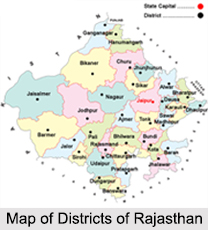
 There are 33 districts of Rajasthan for the sake of administrative purposes and the responsibilities of the district management are carried out by All India Services (AIS) and state appointed officials. The state-appointed officials are responsible for matters such as health, education and agriculture in each district. The 33 different districts of Rajasthan are discussed below and are listed under their 7 respective sub-divisions. There are 33 districts of Rajasthan for the sake of administrative purposes and the responsibilities of the district management are carried out by All India Services (AIS) and state appointed officials. The state-appointed officials are responsible for matters such as health, education and agriculture in each district. The 33 different districts of Rajasthan are discussed below and are listed under their 7 respective sub-divisions.
Jaipur Division This division comprises of five districts namely, Alwar, Dausa, Jaipur, Jhunjhunu and Sikar. Alwar District: As of 2017, the Alwar district is known to be one of the third most populous districts of Rajasthan. The district is also an important hub of agricultural production in Rajasthan. Dausa District: Named after a hill called Devgiri, the Dausa district was constituted in the year 1991 and is now divided into 8 tehsils. Jaipur District: With the city of Jaipur being the district headquarters of the Jaipur district, it is the tenth most populous district in the state and has about 13 sub-divisions. Jhunjhunu District: The Jhunjhunu district is one of the districts of Rajasthan and comes within the historical region of Shekhawati and is bounded on the northeast and east by the state of Haryana. Sikar District: The Sikar District is popular as a pilgrimage place for Khatushyam, an avatar of Lord Krishna. Devotees throng here to celebrate the Darshan of Khatushyam during the months of February and March. Jodhpur Division This division comprises of 6 districts namely, Barmer, Jaisalmer, Sirohi, Jalore, Jodhpur and Pali. Barmer District: Barmer is the third largest district by area in Rajasthan and fifth largest district in India. The Barmer district is part of the Thar Desert and is known for its folk music and dance. Jaisalmer District: As of 2011, the Jaisalmer district is one of the least populous districts of Rajasthan and has 3 sub-divisions. Sirohi District: The Sirohi district is broken up by hills and rocky ranges; the granite massif of Mount Abu divides the district into two portions, running from north-east to south-west. Jalore District: With 5 sub-units, the economy of the Jalore district is mainly based on agriculture and animal husbandry. Of late some mineral based industries are set up based on mineral available from local mines. Jodhpur District: Historic centre of the Marwar region, the Jodhpur district has the ancient town of Mandore and is now popular in terms of tourism. Pali District: Famous for its textiles industry, the Pali district has lots of irrigation dams, ponds, etc and its economy is based on agriculture. Ajmer Division This division comprises of four districts namely, Ajmer, Bhilwara, Nagaur and Tonk.  Ajmer District: An important tourist destination among the other districts of Rajasthan, the Ajmer district is situated in the centre of Rajasthan. Ajmer District: An important tourist destination among the other districts of Rajasthan, the Ajmer district is situated in the centre of Rajasthan.
Bhilwara District: The Bilwara district is famous for its textile industry and though primarily an agricultural economy, the district has managed to make a name for itself in the industrial map of the state. Nagaur District: The Nagaur district has a long historical legacy, going back to the time of the Mahabharata. Tonk District: The Tonk District is located in the north-eastern part of the state of Rajasthan. The district was a stronghold of the Nawabs, and was able to maintain an isolated status in Rajasthan due to its secular nature. Udaipur Division This division comprises of 6 districts namely, Banswara, Chittogarh, Dungarpur, Rajsamand, Udaipur and Pratapgarh. Banswara District: The Banswara district lies in the Mahi River basin and has a rich flora and fauna. Chittogarh District: The Chittogarh district is disjunct, divided into a larger western portion and a smaller eastern portion by the Neemuch district of Madhya Pradesh. Dungarpur District: The district of Dungarpur is roughly triangular in shape and is known to have a dry climate with an average temperature of 40 to 45 degree Celsius during the summer months. Rajsamand District: The district is known to be constituted in the year 1991 and is named after the artificial Rajsamand Lake. Udaipur District: The economy of Udaipur district is primarily dependent on agriculture with 61.7 percent workers in the district engaged as cultivators or agricultural labourers. Pratapgarh District: One of the newest districts of Rajasthan, the Pratapgarh district is famous for its Thewa art and edible jiralun and hing. Bikaner Divison This division comprises of 4 districts namely, Bikaner, Churu, Sri Ganganagar and Hanumangarh. Bikaner District: The Bikaner district is well known for one of the finest schools of miniature paintings that developed here in the state. Churu District: The district of Churu lies in the Jangladesh region with production of crops like bajra and guar and minerals like copper and gypsum. Sri Ganganagar District: The northernmost district in the state, the Sri Ganganagar district is named after Maharaja Ganga Singh of Bikaner. The Indo-Pakistan international border is situated along the western tip of the city. Hanumangarh District: This district comprises of 7 tehsils and is located in the extreme north of the state. Kota Division This division comprises of 4 districts namely, Baran, Bundi, Jhalawar and Kota. Baran District: Out of all the other districts of Rajasthan, the Baran district receives the second highest rainfall in the state after the Banswara district. This district is famous for the Ramgarh crater made from the meteorite strike. Bundi District: The economy of the Bundi district is primarily supported by agriculture, textile and tourism industry. Handicrafts industry also plays a pivotal role in the economic prosperity. Jhalawar District: The name of the district is derived from the erstwhile princely state of Jhalawar. The Jhalawar district lies in the Hadoti region on the edge of Malwa Plateau. Kota District: The Kota district is on of the most industrially developed districts in the state of Rajasthan. The fort situated here is a popular place of tourism in all of Rajasthan. Bharatpur Division This division comprises of 4 districts namely, Bharatpur, Dholpur, Karauli and Sawai Madhopur. Bharatpur District: Famous for its historical fort and palaces like the Lohagarh fort, Fateh Burj and Jawahar Burj. The Bharatpur district in Rajasthan is also well known for its bird sanctuaries. Dholpur District: One of the prominent districts of Rajasthan, the Dholpur district is well known for its red sandstone. The economy of the district is primarily agricultural. Karauli District: The district of Karauli is known for its good grade stone and some iron ore comprise the mineral resources of the area. Sawai Madhopur District: An important tourist destination among the other districts of Rajasthan, the Sawai Madhopur district hosts various fairs and festivals. Out of them the largest Ganesh Chaturthi fair is held in the district where devotees and tourists alike flock to. |
| |||



Districts of Rajasthan
| With about 33 districts, the districts of Rajasthan thrive on agriculture and are subdivided under 7 different divisions. |
| ||||||||||||||||||||||||||||

