


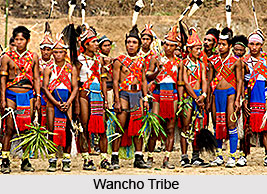
 Wancho Tribes are one of the major indigenous tribes inhabited in the Patkai hills of Longding district in Arunachal Pradesh. They have a population of 35,000. Culturally Naga, they are ethnically related to the Nocte and Konyak Naga of the Mon and Tirap districts. The Wancho language belongs to the Tibeto-Burman family. Wancho Tribes are one of the major indigenous tribes inhabited in the Patkai hills of Longding district in Arunachal Pradesh. They have a population of 35,000. Culturally Naga, they are ethnically related to the Nocte and Konyak Naga of the Mon and Tirap districts. The Wancho language belongs to the Tibeto-Burman family.
Origin of Wancho Tribe Wancho had relation with Naga tribes of Nagaland state like most of the tribal communities of north-eastern states of India; Wancho tribes too are maintaining their ancient tradition and customs intact. They are mainly ‘head hunters’. They share a close affinity to the Nocte and the Konyak Naga residing in Mon and Tirap districts. Society of Wancho Tribe The Wancho tribes lead a very simple life. For better administration, they have formed a council of aged headmen, known as ‘Wangchu-Wangcha’. Since long time, they used to govern the Wancho tribes. They have a peculiar tradition of keeping skulls of the dead man and also display them in few of the dormitories which are popularly known as ‘Murung’. The Wancho fathers impart training to the young Wancho boys in the dormitory so that these boys grow up as perfect man. 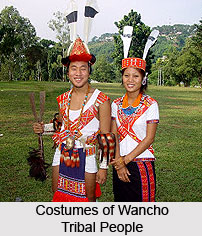
Tattooing is considered as another unique custom that they have adopted from their ancestors, thus helping these tribal people to reminisce about their golden past. As per their conventional norms, a male Wancho draws beautiful tattoos on his legs and face. The women embellish themselves with exquisite jewelleries like necklaces and bangles. Little bit of tattooing also acts as jewels thereby making these beautiful Wancho women even more beautiful. Religion of Wancho Tribe In spite of having close relation with Nagas in past years, Wancho were not deviated from their original practices of religion. Till date, they religiously follow the practice of Animism. They believe that all natural objects and the universe itself have souls. These Animist Wancho believers had immense faith on the existing powerful deities, popularly known as ‘Rang’ and ‘Baurang’. Apart from them, there are quite a few Wancho people who have adept to the religious practices of those of Protestant Christians. Festivals of Wancho Tribe Several festivals highlight the cultural exuberance of Wancho tribes. Amongst these festivals, the main festival of the Wancho is ‘Ojiyele’, usually held in the months of March to April for a period of 6 to 12 days. The villagers exchange bamboo tubes filled up with rice beer thus marking the salutation and grace. As a mark of honour and respect, pork skin is then given to the village chief. A long ceremonial pole, popularly known as Jangban, has been built during the Ojiyele festival where all men and women of the Wancho tribes dance in great enthusiasm. |
| |||



Home > Society > Indian Tribals > Indian Tribal People > North East Indian Tribes > Tribes of Arunachal Pradesh > Wancho Tribe
Wancho Tribe
| Wancho Tribes are related to the Naga tribes of Nagaland and are scattered in the Longding district of Arunachal Pradesh. |
| ||||||||||||||||||||||||||||

