


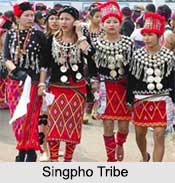
 Singpho Tribe is numerically a minor tribe in North-East India. They are found in Tirap district and some parts of the Lohit district of Arunachal Pradesh and Tinsukia district of Assam. They are scattered in villages like Ketetong, Ulup, Dibang, Pangsun, Mungbhon, Bisa, Pangna, Hasak, Namo, Ingthem, Katha and Kumsai. The proper tribal name of Singpho is ‘Ching-po’. The Singphos are the most powerful tribe bordering on the valley. They drove out the Khamtis from the low lands under the Patkai hills and settled themselves on the bank of Tengapani, east of Sadia and on the upper Buri-Dihing in Namrup. Singpho Tribe is numerically a minor tribe in North-East India. They are found in Tirap district and some parts of the Lohit district of Arunachal Pradesh and Tinsukia district of Assam. They are scattered in villages like Ketetong, Ulup, Dibang, Pangsun, Mungbhon, Bisa, Pangna, Hasak, Namo, Ingthem, Katha and Kumsai. The proper tribal name of Singpho is ‘Ching-po’. The Singphos are the most powerful tribe bordering on the valley. They drove out the Khamtis from the low lands under the Patkai hills and settled themselves on the bank of Tengapani, east of Sadia and on the upper Buri-Dihing in Namrup.
Origin of Singpho Tribe Singpho tribal group is said to be the sub group of the Burmese tribe named ‘Kachin’. According to some historians the Singpho were formerly inhabitants of Upper Burma. According to their own belief, they were the inhabitants of the Hukang Valley in the north-east of the Patkai ranges. The Singphos are of the Mongoloid racial stock. The dialect used by them belongs to the Tibeto-Burman branch of the main Sino-Tibetan family. Society of Singpho Tribe The Singpho tribes are segregated into quite a number of clans, each under a leader locally known as ‘Gam’. The principal Gams are the Bessa, Duffa, Luttao, Luttora, Tesari, Mirip, Lophae, Lutong and Magrong. The Singphos are also separated into 4 classes, known as Shangai, Myung, Lubrung and Mirip. Their numerous clans have their own leaders, and they live in the houses on stilts. Traditionally the king is the chief of the Singpho community. There are systems of Gaon Panchayat and Anchal Samity for administrative structure of the community. Gaon Panchayat is headed by village headman. Moreover, the social customs of the Singpho tribes are maintained with honour. Marriage is a valued institution. ‘Exogamy’ is adept to marriage. However, it is customary that they do not marry within the members of a clan. Only marriages are being confined to definite clans. Once a man gets married to a clan, it becomes customary for his heirs to seek wives from the same family line only. Occupation of Singpho Tribe 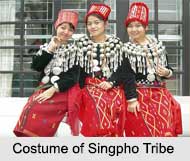 Traditionally they are hunters and gatherers. Since hunting is a strenuous work they have resorted to agriculture that has gone to become the main source of livelihood. They are very fond of opium. This habit is a characteristic feature of the Singphos. All the Singpho tribes have developed expertise in their professions of being blacksmiths, largely producing iron artworks of excellence. Mainly the women folks create nicely woven clothes and dress materials. Traditionally they are hunters and gatherers. Since hunting is a strenuous work they have resorted to agriculture that has gone to become the main source of livelihood. They are very fond of opium. This habit is a characteristic feature of the Singphos. All the Singpho tribes have developed expertise in their professions of being blacksmiths, largely producing iron artworks of excellence. Mainly the women folks create nicely woven clothes and dress materials.
Religion of Singpho Tribe They are Buddhist by religion and the Buddhist Monk is a greatly revered figure in the Singpho community. He plays a significant role as far as social ethos and moral values are concerned. Costume of Singpho Tribe The people of this community make shields and helmets from buffalo hide and they are decorated with artistic touch. The Singpho males wear coloured cotton jacket to cover their upper portion. Some of the people of this tribal community have also adopted the costume pattern of the Burmese or Shan. The females of this community wear Mekhala that covers the entire body and embellish their hair with beautiful silver chains. Tattooing is also in vogue amongst the married females. Exquisite tattoos are drawn on the legs covering ankles, knees, etc. Man does not prefer to wear jewelleries, only the female folk deck up in conventional neckpieces, earrings and finger rings. They carry a sword, locally popular as ‘sheathed dao’. The sword that the leader carries has been engrafted with tiger claws. Festivals of Singpho Tribe The pious Singpho tribes feted festivals in great jubilance. Especially the religious festivals are greatly popular amongst the Singpho tribes. In the month of April, the ‘Songkon festival’ is a special festival that they celebrate in memorial of Lord Buddha. In their cultural traditions are infested in various art forms like music, dance, festivals, the Singpho tribes maintains uniqueness. |
| |||



Home > Society > Indian Tribals > Indian Tribal People > North East Indian Tribes > Tribes of Arunachal Pradesh > Singhpo Tribe
Singpho Tribe
| Singpho Tribe of Arunachal Pradesh resides on the banks of Siang and Noa Dihing rivers and spreading to as far as the south-eastern part including the land of the Khamtis. |
| ||||||||||||||||||||||||||||

