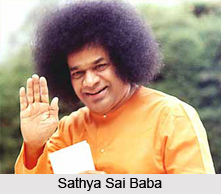
 Sathya Sai Baba was born in the remote village of Puttaparthi on 23rd November 1926, located in Anantapur district, Andhra Pradesh. Initially his name was Sathyanarayana raju. The birth of Sathya Sai Baba is again laced with myths and miracle. Professor Narayana Kasturi, in his official four-volume hagiography (study of saints), wrote about Sathya Sai Baba`s mother that after dreaming of the Hindu god Sathyanarayana, a huge sphere of blue light rolled towards her, merged into her which made her faint, she found out she was pregnant. Even as a child, his spiritual disposition and ruminative nature set him apart from other children of his age.
Early life of Sathya Sai Baba
Sathya Sai Baba at his young age was a vegetarian and was known for his antipathy to animal cruelty and sympathy for the poor, disabled and elderly. At the very young age of 8, Sathya started composing bhajans spontaneously. In 1960 Sathya Sai Baba said that for 59 years more, he would be in this mortal human form. In the year 1963, he claimed to be a reincarnation of Lord Shiva and Shakti in a discourse. He also claimed that his future reincarnation - Prema Sai Baba - would be a reincarnation of Shakti and Prema Sai Baba will be born in the state of Mysore.
On 20th October1940 in his 14th year, he proclaimed himself to be a reincarnation of the `fakir` and saint Shirdi Sai Baba (circa 1838-1918) and later on took the fakir`s name. Sai Baba exacted to be the avatar sent for the betterment of this world. Today, he is worshiped as and `Avatar` by millions of devotees from all over the world, who are professing various faiths, and heralding from various walks of life.
Sathya Sai as a Spiritual Leader
Sri Sathya Sai Baba is a combination of two very noteworthy roles. Firstly, He is regarded as a great spiritual Master, renowned for His simple and sweet exhibition of the greatest and most complex of spiritual truths that form the first harmonic teachings of all the religions of the world. In order to lead meaningful life, he has formulated the five-fold path of Sathya (Truth), Dharma (Righteousness), Shanthi (Peace), Prema (Love) and Ahimsa (Non-Violence). His prescriptions for our ailing world are - Love for God, fear of sin and morality in society.
 Secondly, He is conceived as an infinite source of pure love. His many service projects, like free hospitals, free schools and colleges, free drinking water supply or free housing projects, all stand as the testimony to His selfless love and heartstrings for the needy and less privileged.
Teachings of Sathya Sai Baba
He stresses that humans should always be free from desires and states that desires bring mental pain like depression, anger, jealousy and so on. His main mission is to spread love and to unify all world religions and avows that people do not need to give up their original religion in order to follow him. His followers view his teachings as syncretism (uniting all religions). Sathya Sai Baba always places exceptional emphasis on the role of women (especially mothers) in society as they build society, apart from teaching the unity and equality. Sathya Sai Baba`s teachings are said to be accomplished abiding by the four principles.
# there is only one Caste, the Caste of Humanity;
# there is only one Religion, the Religion of Love;
# there is only one Language, the Language of the Heart;
# there is only One God and He is Omnipresent
Sathya Sai Baba`s main ashram called `Prashanthi Nilayam` at Puttaparthi, where he resides much of the time. Puttaparthi is a small village where Sathya Sai Baba was born and still lives. Sathya Sai Baba established three primary mandirs in India ("Dharmakshetra" or "Sathyam" in Mumbai, "Shivam" in Hyderabad, "Sundaram" in Chennai).
Charity work of Sathya Sai Baba
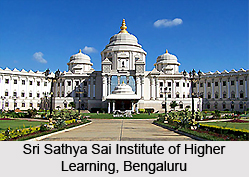
The Sri Sathya Sai Organizations are there in over 167 countries in the world. Some of the organizations namely are: The Sri Sathya Sai Institute of Higher Learning in Prashanti Nilayam, The Sri Sathya Sai Institute of Higher Medical Sciences in Puttaparthi known as the Super Specialty Hospital, The Sri Sathya Sai Institute of Higher Medical Sciences in Bengaluru is a hospital meant for the benefit of the Poor.
Several general hospitals, two super specialty hospitals, dispensaries, eye hospitals and mobile dispensaries are run by The Sri Sathya Sai Central Trust and also conduct medical camps in rural and slum areas in India. Several major drinking water projects are also funded by The Trust, like "Sathya Sai Ganga Canal", water project in the Anantpur district in Andhra Pradesh, on the Godavari River for the five hundred villages in East and West Godavari Districts, the Medak District Project, the Mahbubnagar District Project and another project in Latur, Maharashtra would be undertaken.
Sathya Sai Baba was admitted to a hospital at Prashantigram at Puttaparthi on 28 March 2011. He was suffering from respiratory problems. His condition was deteriorating and he died on 24 April 2011 at 7:40 am.