 Magh tribe of East India has actually migrated from the hilly neighbourhood countries of India. The term `Magh` has got etymological significance as it means Mongoloid. The Magh society has rich heritage as exemplified in its cultural aspects.
Magh tribes have their own local dialect for carrying on conversation amongst each other. Riddles, proverbs and folk tales are part and parcel of the Magh tribal community. In the social structure, the priest who is locally known as Phongyee, play a significant role for the preservation of conventional education system in the Magh society. Compared to other religious groups, the literacy rate among Magh tribes is higher due to the existence of Phongyee in the Marga localities. To suffice the requirements, Magh boys and girls use to study in usual schools and colleges, built in and beyond their locality.
Occupation of Magh Tribe
The main occupation of Magh tribes is agriculture. People those who live in the mountainous terrains, undertake the practice of jhum cultivation. While some people residing in the plains plough cultivation, weaving and fish catching are also taken up by many of them. Business community, traders and service holders are barely ever found in their society. Child labor is unfamiliar, and also Magh females are seen working in the construction sites and field.
Society of Magh Tribe
Since the society is patriarchal, the eldest man becomes the head of the whole family. However, the status of females in the Magh society is no less insignificant. In fact a Magh female has got ample freedom in respect of several things like divorce, marriage, and also owning property. Two kinds of marriages, namely, exogamy and endogamy are prevalent in the Magh society. Also widow marriage is permissible. Ragratha, Maratha, Ramratha are various classes of this tribal society. Leaders, priests, chieftains hold esteemed positions in the whole of the Magha society.
Religion of Magh Tribe
These Magh people are religious minded, widely practicing Buddhism. They are mainly the followers of theravada (hinayana) Buddhism. Tripitaka is the sacred book of Magh tribe, written in the Pali language. The Monastic and the Laity are religious communities. The priests wear yellow robes and live in the religious residence, while the Laity leads a family life with wife, children and relatives.
Festivals of Magh Tribe
Festivals are an integral part of Magh tribe, mostly associated with the full moon of each month, which they call labray, a Burmese word for full moon. To them the full moon is sacred and they believe that most religious events take place on the day following the night of the full moon. On this occasion, Buddha is worshipped and various ingredients like food, fruits and flowers and by lighting candles and incense sticks are being offered.
Also, Magh tribe gives donations to the hapless; abide by a code of conduct, popularly known as `sila` and also meditation, known as `bhavana`. Apart from celebrating these practices, they also worship trees and rivers. Water festival comprises of one of their popular form of amusement. Like all other festivals of other tribes of the whole country, dance and drama, popularly known as `zatpwe` and `yeinpwe`, provide ample pleasure and entertainment to the Maghs. Zatpwe comprises of the folklores of the Buddhists and also the life stories of primitive Buddhists kings, and also the yeinpwe tantamount to the style of ball dancing.
Food Habits of Magh Tribe
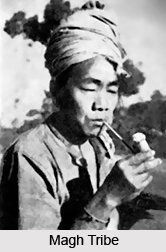
The major food of Magh tribe is a type of boiled rice and vegetables mixed with lots of chilies and salt. Delicacies are Nagpy, a type of dish prepared from rice cakes, known as Mundi, and also soup. Drinking raw tea called Lapsy, after meal is the usual practice among this tribal community. Magh tribe smokes cheroot with the help of pipe. Few of the people of Magh tribe savour a type of alcohol, known as `Arey`. It is prepared locally.
Attires of Magh Tribe
Amongst dresses of these Magh people, males wear lungis or sarongs, shirts and slippers. As festival wears, they prefer to wear tight fitting coat called `prakha angyi` over the shirt buttoned at the throat. They also use a white kerchief called `goungpoung`. It is a type of headdress. Tattooing, locale known as matoray, beautifies their bodies. Usage of shirts and trousers are common among the aristocrat people of this community. The women of Magh tribal group wear angyi (blouse) and thami along with a tuft known as chaungtung on head. Flowers and jewelleries are also used by the women folks to bedeck their hair. Salwar kamiz is also popular among the Magh women.
People of Magh Tribe
Magh tribes have got well built body and also maintain cleanliness. In the ancient period, they had to depend on local medicines made from certain kinds of plants and herbs. This system is popular as Magha Shastriya Aushad. However, these people, especially the young generations, adapt to the modern treatment. The houses of the Maghs are made of bamboo and grass. Their house is built in a particular manner by making them on high platform which is called machang. The houses are well-ventilated and fenced. They have separate rooms for cooking and living.