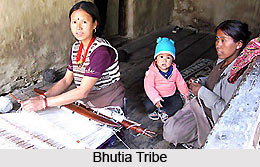
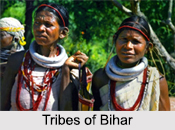
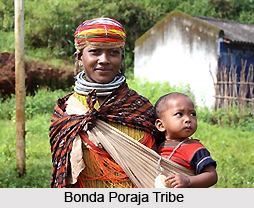
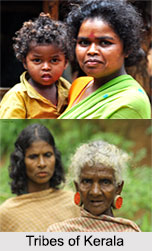
 The concentration of the Juang tribes is in several places including Banspal, Telkoi and Harichandanpur blocks. For better living, the Juang villages have been established mostly on the plains. They are also located in ample number in Keonjhar and some are scattered in Dhenkanal. However, most of the Bathudi tribes have adapted to the modern lifestyle of people and immigrated to other places of the region.
Juang people are basically a jungle tribe and are divided into two broad sections, namely, Thaniya and the Bhagudiya. Thaniya comprises of those of the Juang tribes who have settled down in the original homelands, while the Bhagudiya are those Juang people who have migrated to some other places.
The origin of these Juang tribes has a history behind it. The Juang tribes believe that in primitive times, they originated from earth on the Gonasika hills. In these hills the river Baitarani has its source and it is also not far from the Honda village in Keonjhar. The etymological significance of the word Juang emphasizes the fact of their origination man from the same place. Juang are also called by the name of `Patuas` meaning `leaf-wearers`. According to some people, the Juang tribes can also be referred to be patra-savaras, where the patra signifies leaf. By citing this reference, these Juang tribes are thought to belong to that subdivision of the Savara tribe whose tribal members dress themselves in leaves. The physical appearance of the Juang people is noticeable for their broad noses, flat faces, large mouths, wide nostrils and thick lips. Their complexion is reddish brown.
The languages of these Juang tribes belong to the Munda group of people. They have got their individual dialect, which has been referred as Kolarian by the eminent scholar Col. Dalten. Due to its influence of several Oriya speaking people, these Juang tribes have incorporated several Oriya words. Recently, the Juang people have become well conversant in Oriya language.
Societal structure of the Juang tribes is formed in such a way so that these can retain their originality and ethnicity. Just like any other tribal people, the village of the Juang tribe too is the biggest `corporate` group with individual province under their jurisdiction. Within the defined land boundaries these Juang tribes have their land practicing both `settled` and shifting cultivation. Primarily, the Juangs were gatherers and hunters later they also developed cultivation. Apart from adapting to the common profession of cultivation, some of the Juang tribes also have taken up weaving, tailoring etc. Some of the Juang tribes too exploit the forest resources and thus sustain their livelihood. Apart from these, they were also adept in making baskets and they used to exchange foods and money from it.
Dormitory plays a significant role in the Juang society. It is also called Majang where their conventional dance takes place and the village Panchayat also used to be organized. It is also regarded as a guesthouse for all the visitants to the Juang village. The Pradhan is the head of the village and the village is better known as Nagam or Boita or Dehuri. The village priest also is part of the conventional village Panchayat of the Juang tribe. The Juang tribes follow the patrilineal norms. In this Juang tribal society Totemistic clans too are also found, which are carved up into two distinguishable groups known as “Bandhu clans†and “Kutumba clansâ€. What is to be noted that the totem is not be damaged or wronged by its members. The clans are mainly exogamous and thus the marriage within the same clan is permissible.
Marriage is an important institution of the Juang tribes. Monogamy is usually prevalent and also polygamy is not utterly prohibited. `Levirate and sororate` marriages are prevalent amongst the Juang tribes. There is a peculiar ritual common amongst the Juang tribes. A Juang husband generally worships the `Sajana`, the drumstick tree, if his wife turns out barren and also provides her a paste made of `Sajana` flowers and seeds for consumption. Sometimes he also ties a sevenfold cotton thread having seven knots around the neck of his wife, thinking it to be a type of "talisman" which will help her to conceive. After conception also certain more rituals are followed. The Juang tribes do not permit their pregnant women to go to `Devisthan`. There are certain things that she should be refrained from, like tying up of any thing, weaving mat and also plastering house with mud.
The Juang tribes fete quite a number of festivals, which enrich their religious exuberance. Especially numerous religious festivals are held in commemoration of worship of several deities in honor of their gods and goddesses. For these Juang tribes, Dharam Devta and Basumata are the principal gods. "Gramashree" is the village deity .They also believe in spirits and ghosts. Apart from worshipping local tribal deities, they also worship Hindu gods and goddesses. They offer fowls and animals to their gods and goddesses.
Few harvesting festivals too are popular amongst the Juang tribes, including Pusha Purnima, Amba Nuakhia, Pirha Puja, Pirha Puja, Akhaya Trutiya, Asarhi, Gahma etc. Dancing and singing mark all these occasions. They celebrate these occasions with dances and songs. A kind of drum called changu is accompanied during dancing performance.