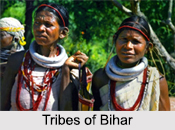
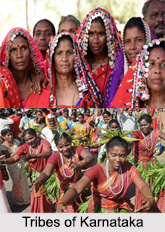
Gorait tribes are a part of the proto-australoid group and are of Austric racial group. These Gorait prefer to settle down in hilly areas densely covered with forests and greenery. Due to their friendly and lovable nature these Gorait tribes shared very good relations with all the other tribal communities who also live in close proximity. Gorait tribes reside in the hilly areas of Bihar region. This tribal community is settled in some parts of Palamu, Sathal Pargana, Singhbhum, Dhanbad, Ranchi, and Hazaribagh.
Gorait tribes have a heritage of rich culture and tradition as reflected in various aspects like marriages, attires etc. This tribe inhabit with the other tribes and communities that has enriched their culture. The style of making houses differs from district to district. However, all these Gorait tribes follow a common pattern. In general, these Gorait tribes raise one roomed house with kitchen, bed and storage. Rightly adjacent to the house is a verandah, which these Gorait tribes utilizes mainly cattle shed. This cattle shed is sheltered by wooden and bamboo pillars.
According to the anthropological evidences, most of these Gorait tribes have taken up the occupation of farming and irrigation. Various tools like Khamti, khurapi, axes, sickles etc. are used to carry on these works. Some of them also work as drum players, village messengers and watchman. Apart from these, some of them even involve in works of weaving. Beautiful items namely, baskets, mats, brooms, winnow tray etc are made by these Gorait tribes so that they can carry grains and goods to various places and also for restoring goods and commodities. It is only natural that the economy of this Gorait society too is agrarian.
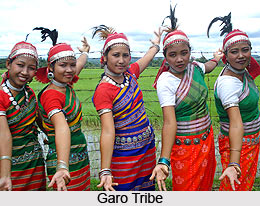
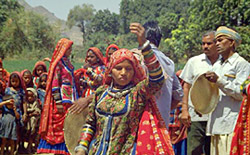
The Gorait tribes are also involved in hunting and making various kinds of weaponry. These weapons include bow-arrow, Lathi, Ber, Barchha. Besides they are also known to make musical instruments, like, Dhol, Manar, nagara, flute and others. For both Gorait males and females, unique dresses are prevalent. Men wear a shirt and dhoti. Women wear saree and blouse. Also the women folks are very much fond of ornaments, chiefly made up of steel, thread, glass and silver etc.
The societal structure of these Gorait tribes comprises elements of any other patriarchal system. The smallest segment is family, that too the nuclear one, comprising of parents and unmarried siblings. There is also unique feature that can be found out in this Gorait society. Although the authoritative power lies in the hand of the father or any other male, the head of the family, he takes consideration of the opinions of both of his wife and children especially those related to selling and purchase of commodities, marriage, invitation, dresses, worship, social relation, feast, cow, goat, chicks, ducks etc.
The society of this tribal community is administered by the Panchayat. The Panchayat Pradhan who is the Panchayat head, create and implement laws for the tribal society. The members of the Panchayat are closely associated with each other to maintain the administration properly. Moreover, the lineage and succession among the Gorait tribes is patrilineal. The families belonging to one lineage stay together and assist each other at times of trouble, miseries and the performance of ceremonies. The property of the father is inherited by all his sons equally. However, the daughters of these Gorait tribes receive only maintenance and bride price. The rule of `primogeniture` and `ultimogeniture` is absent in the Gorait tribal society. Husband`s brother`s sons inherit the property of barren couple and also have to look after the old couple through out their life. He also inherits the property of the widow.
There are numerous clans within the Goriat tribes based on `totemism`. Few significant `totemic` Gorait clans are Indnar, Tudu, Khalkho, Toppo etc. Marriage within the same clan is rigorously forbidden. Thus they follow the rules of tribal endogamy and clan exogamy. The Gorait maintains prohibitory rule in case of cousins and relatives up to three generations from the sides of both of the parents. Quite often widow remarriage is also widespread in the Gorait tribal society. Divorce is also permissible.
Religion too is quite enriched. In fact the religious practices are a blend of manaism, animism, animalism, naturalism, Bongaism, witchcraft and Sharananism. Also these Gorait tribes ardently believe in the concept of rebirth of man. They believe in different Gods, Goddesses and spirits. They also believe in ancestral spirits, who according to them, dwells in Saranagrove. Jalalbonga, Dubal Bonga, Katal Bonga, maral Bonga etc deserve to be mentioned. Significant deities include Vana Deo, Vana dei, Burha Deo, Burha Dei, Thakur Deo, Gram Deo, Dihawar Deo, Nag Deo, Bagh Deo, goddess Kali etc. They celebrate festivals like Karma, Sarhul, Jitia, Sohrai, Nawakhani, Maghi and Phagu.