Bhunjia is a small Dravidian tribe residing in Raipur District, Chhattisgarh and Odisha region numbering about 7000. Bhunjias are a primitive tribe of Odisha and their homeland is the Sunabeda plateau which is now in Nuapada district, Odisha. The Bhunjias are divided into two branches, `Chaukhutia` and `Chinda` and the former have the following legend of their origin.
History of Bhunjia
According to the legends, the Bhunjia have the racial and cultural similarity with the Gonds of Odisha. There are a lot of myths among the Bhunjia and the Gond, which speak of the strong relationship among the Gonds and the Bhunjias. On setting in the Sunabeda plateau, the Bhunjias did not have married relations with any tribal group, but in course of time, when the Gonds came into their region, matrimonial relation was established with them. From this the population was divided into two inter-marrying groups, namely "Markam" and "Netarn".
According to the legends, on one circumstance, "Bhatra Gond" named "Bachar" cast a net into the Pairi River and brought out a stone. He then threw the stone back into the river and shed his net again, but a second and yet a third time the stone came out. So he laid the stone on the bank of the river and went back to his house and that night he dreamt that the stone was Bura Deo, the great God of the Gonds. The stone then called upon the "Gond" to worship him as Bura Deo. Bura Deo agreed to this but said that "Bachar" must marry his daughter to the substituted worshipper. The Gond then set out to look for somebody and in the village of "Lafandi where he found a "Halba" of the name of "Konda", who was a cripple, deaf and dumb, blind and a leper. He brought Konda to the stone and he was unbelievably cured of all his ailments and willingly began to worship Bura Deo.
He afterwards married the Gond`s daughter and they had a son called Chaukhutia Bhunjia, who was the ancestor of the "Chaukhutia" division of the tribe. It is clearly with this end in view that the Gond is made to demur to worship the stone himself and promise to find an alternative, an incident which is completely deviant and is simply dragged in to meet the case. The "Chaukhutia" sub-group especially worships Bura Deo and sings a song relating to the finding of the stone in their marriage ceremony. "Thakur Deo" is the title given to the divine stone; "Konda" is the "Halba" priest, and "Bachar the Gond" who cast the net.
Language of Bhunjia
They speak Halbi language, a mixture of Oriya, Marathi and Chhattisgarhi. Bhunjias surrounded by the Gonds on all sides, did not speak Gondi but a dialect of Hindi, which Sir G. Grierson considered to look like that of the Halbas, and also describes as "A form of Chhattisgarhi which is almost the same as Baigani".
 Subdivisions of Bhunjia
Bhunjias are divided into two main sections namely "Chinda Bhunjia" and "Chaukhutia Bhunjia". The "Chaukhutia Bhunjia" is confined completely to the hills of the Sunabeda plateau in ecologically private areas for which they keep up the distance from the outsiders. However, the "Chinda Bhunjia" usually lives in the plains and have close contact with the other tribal and non-tribal communities.
Etymology of Bhunjia
The term "Bhunjia" signifies one who lives on the soil, the earth, and "jia", dependent on. The word "Birjia", a synonym for Binjhwar, is likewise a sleaze of "bewar jia", and means one who is reliant on "dahia" or patch farming.
Culture of Bhunjia
The two sub tribes of Bhunjia are mentioned the "Chaukhutia" and are recognized to be of unlawful descent. Chaukhutia does not eat food cooked by other members of his own community and this is a control found only among those of descent. He will not take food from the hands of his own daughter after she is married. After the marriage ceremony, her belongings are at once removed from the hut, and even the floor under the seat of the bride and bridegroom throughout the marriage ceremony is dug up and the surface is thrown away to keep away from any risk of ruining.
Among the Chaukhutias, it is considered as a great misdeed if the signs of youth appear in a girl before she is married and to stay away from this, if no husband has been found for her, they perform a `Kand Byah` or `Arrow Marriage`. In this, the girl walks seven times round an arrow fixed in the ground and is given away with no ritual to the man who by the preceding arrangement has brought the arrow. If a girl is a Chaukhutia then it is believed that she is ultimately banished from the community and the same brutal choice is being adopted even when she is not pregnant. The proposal for marriage among the Chaukhutias is made on the boy`s behalf by two men who are known as "Mahalia" and "Jangalia", and are supposed to represent a "Nai" (barber) and "Dhimar" (water-carrier). As among the Gonds, the marriage takes place at the bridegroom`s village, and the "Mahalia" and "Jangalia" act as keepers of the rite and are commended with the rice, salt, oil and other requirements while the bridegroom`s family have no function in the matter except to pay for them.
The requirements are all stored in a separate hut and when the time for the feast comes they distribute the requirements to all the guests. The marriage is solemnized by walking round the sacred post and the ceremony is conducted by a hereditary priest known as "Dinwari", a member of the tribe, whose line it is believed will never become extinct. Among the Chinda Bhunjias, the bride goes away with her husband, and to make an offering to the deities she returns with him to her parents` house for a few days. However, the Chaukhutias do not allow her after she has lived in her father-in-law`s house, to return to her home.
In future, if the girl goes to visit her parents then she must stay outside the house and cook her food individually. Widow-marriage and divorce are permitted, but a husband will often ignore sins on the part of his wife and only put her away when her behavior has become dishonor. In such a case, he will either silently leave house and wife and settle alone in another village, or have his wife informed by means of the fellow people that if she does not leave the village then he will do so. The marriage of a brother`s son or daughter to a sister`s daughter or son is considered the most appropriate. A man will not let his sister`s children to eat the leavings of food on his plate, though his own children may do so.
Religion of Bhunjia
The religious life of Bhunjia is very simple. They believe in many Gods and Goddesses. Every third year in the month of "Chaitra" (March), the tribe offer a goat and a coconut to "Mata", the deity of cholera and smallpox. They worship daily to the Sun and believe that he is helping them in the insolvency of debt. When a debt has been paid off, they offer a coconut to the Sun as a mark of gratefulness. They also worship the tortoise.
They call the tortoise the "footstool" (pidha) of God and have adopted the Hindu theory that the earth is supported by a tortoise swimming in the midst of the ocean. It is said that Bhunjia women are never allowed to sit either on a "footstool" because these are considered to be the seats of the deities. They consider it impertinent to walk across the shadow of any old person, or to step over the body of any human being or revered object on the ground.
Lifestyle of Bhunjia
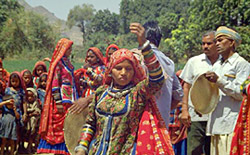
The costumes of the Bhunjia tribal people are very colourful and attractive. The men generally wear a piece of cloth and shirts. Sarees and different jewelleries adorn women of this community. Ornaments like bangles, ear-rings, necklace, anklets etc are some of the jewelleries prevalent among women.
Society of Bhunjia
Bhunjia tribes are conservative and follow the traditional system with formation of village council as the key unit of village administration. Bhunjia tribe eats pork but give up from beef and the flesh of monkeys. A man who has got maggots in a wound is purified by being given to drink water, mixed with powdered turmeric, in which silver and copper rings have been dipped. Women are isolated during the menstrual period for as long as eight days and during this time they may not enter the house or touch any object belonging to it.
The Bhunjias take their food on plates of leaves and often a whole family will have only one vessel. When the women go out to work they carry their babies tied up in a small rag under the arm. They have no awareness of medicine and their solution for most diseases is branding the skin with a hot iron, which is employed unconcernedly for headache, pains in the stomach and rheumatism. It is also said that Bhunjia tribes have excelled in the art of dreadful magic and spells.