


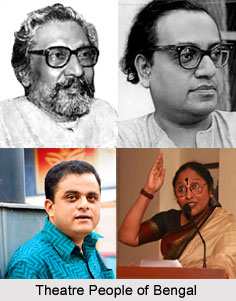
 Bengali theatre, initially, developed as a protest against the administration of British Empire, and later became a major form of art among the people of Bengal. Theatre in Indian under British rule, sowed the seed of contemporaneousness which, gained a rather articulate contour in the hands of the famous theatre personalities if West Bengal like; Girish Ghosh, Bonodini Dasi, Badal Sircar and so on The aim was then to make the mass aware of the then socio political scenario. Quite ideally therefore the playwrights, director and even the actors in Bengali theatre with their unparallel contribution illustrated the colonial fragrance in perhaps the right way. That was the beginning of the journey. It was much later the overall concept of Bengali Theatre as a representation of the age-old British colonialism gradually faded away and theatre became lot more naturalistic. The concept of mirroring the unedited realities of life became so popular within a short span of time that a whole new conception of Realistic theatre in Bengali took place. Bengali theatre, initially, developed as a protest against the administration of British Empire, and later became a major form of art among the people of Bengal. Theatre in Indian under British rule, sowed the seed of contemporaneousness which, gained a rather articulate contour in the hands of the famous theatre personalities if West Bengal like; Girish Ghosh, Bonodini Dasi, Badal Sircar and so on The aim was then to make the mass aware of the then socio political scenario. Quite ideally therefore the playwrights, director and even the actors in Bengali theatre with their unparallel contribution illustrated the colonial fragrance in perhaps the right way. That was the beginning of the journey. It was much later the overall concept of Bengali Theatre as a representation of the age-old British colonialism gradually faded away and theatre became lot more naturalistic. The concept of mirroring the unedited realities of life became so popular within a short span of time that a whole new conception of Realistic theatre in Bengali took place.
Bengali plays have a direct connection with Jatras as in the initial days Bengali plays were influenced by the folk plays acted on the open stage. Religion, myths, tradition and customs then were the core theme of the Bengali plays. Bengali plays witnessed a massive change during and after the independence of India. The Bahurupi culture in West Bengal also helped in promoting this performing art in a major way. 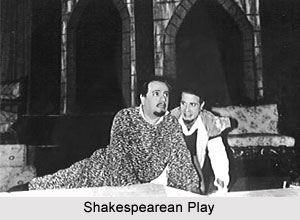 Blessed with its rich heritage, the history of Bengali theatre is the saga of the journey of theatre in Bengal. Started as a naive effort in 1779, Bengali theatre, gradually gained a remarkable dimension whilst sowing the seed of contemporaneousness in Indian drama or theatre. The year was 1795 and it was for the very first time the then intelligentsias of Kolkata witnessed Bengali theatre as the Russian dramatist Horasim Lebedev along with a Bengali theatre connoisseur Goloknath Das staged the Bengali translations of two English comedies, "Disguise" and "Love Is the Best Doctor" in Kolkata. That was the time since when Bengali theatre started its journey. With few unstable steps and later with long strides it was with time, Bengali theatre gained a redefined dimension. By the year 1831 Bengali theatre became a whole new art form to mirror the then Bengal amidst its artistry.
The start of modern Indian theatre can be sketched to constructing of Calcutta Theatre in 1779. In the year 1795, Horasim Lebedev, a Russian dramatist, along with Goloknath Das, a Bengali theatre lover, staged the Bangle translation of two English comedies "Disguise" and "Love is the best doctor" in Kolkata. In 1831, Prasanna Kumar Thankur, set up "Hindu Rangamanch" at Kolkata and also staged Wilson's English translation of Bhavabhuti's Sanskrit Theatre "Uttar Ramachiritan" laying the groundwork for modern theatre in India. Other essential efforts on Bengali theatre scene include Jorasanko Natyashala (1854), private theatre stage by Ramsay Basak and Ashutosh Deb (1857), Vidyotshini Mancha (1857), Metropolitan Theatre (1859), Shobhabazar Private Theatrical Society (1865), Bagbazar Amateur Theatre (1868) and Bahubazar Natyashala (1866). 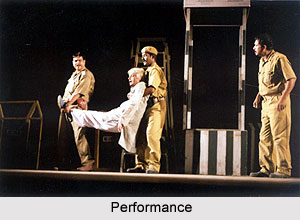 Development of Bengali theatre and its consolidated rise can be attributed to the two major players during that era- the Star and the Minerva. The Star Theatre was set up in 1883, by a group of actors led by Girish Ghosh. The money for building the playhouse was advanced by another Rajasthani businessman, mainly at the instance of Binodini Dasi. The new playhouse opened in July, 1883 with a mythological play by Girish Ghosh. It soon led the other playhouses in fame and popularity. However, the band of actors and actresses who had made Star the leading theatre left when, four years later, it was purchased by a wealthy landowner. They raised money and built a new playhouse at the site where Star Theatre now stands.
Eminent personalities of Bengali theatre supported in crafting it as the refined technique of illustrating the unedited realities of life in Natya Dharmi in Bengal! Bengali theatre continued its journey through "Kirtivilas" of Yogendra Chandra Gupta, Neel Darpan' of Dinabandhu Mitra and gained a colossal maturity in the hands Bengali theatre personalities. The theatre personalities like Shombhu Mitra and Utpal Dutt can be credited in making Bengali Theatre a representation of the unaltered realities of daily life and social issues. Dwijendra Lal Roy, in his play "Mebar Patan" reinvented the style of historical plays in Bengali theatre. It was much later the socio political issues like the partition of Bengal 1905, Bengal famine of 1943 and the regional socio political scenario were also introduced into Bengali theatre. The structure of the stages in Bengali theatre then gained a contemporary diction. The famous stages in Bengali theatre still bear this rich history of Indian Natya so very expressively. The most famous stages of Bengali theatres are Star Theatre, Rabindra Sadan, Girish Maanch, Academy Of Fine Arts etc. Bengali theatre with its copious tradition started as a protest against the British imperialisms. It was with the introduction of modern Bengali theatre and later with the contemporary Bengali Theatre, the socio political and financial issues were clearly illustrated amidst the roopaka and natya of the Bengali theatre. More Articles in Personalities In Indian Theatre: |
| |||



Home > Movies & Entertainment > Indian Drama & Theatre > Regional Theatre in India > Bengali Theatre
Bengali Theatre
| Bengali theatre had developed as a prominent form of protest movement during the colonial period. But with time it has made a niche for itself. |
| ||||||||||||||||||||||||||||

