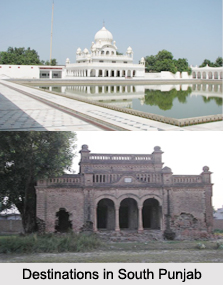
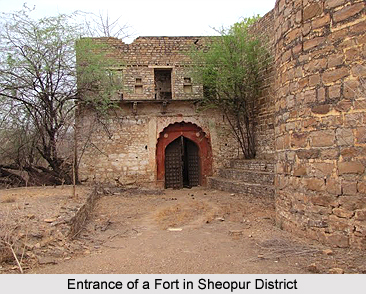
 Sheopur district is located in the north of the state and forms part of Chambal Division. The well-known Kaketa reservoir is located in this district. The art of woodcarving has flourished in district Sheopur and the beautifully embellished wooden ceilings, doors and lintels with finely carved designs are silent testimonials of its glory.
Geography of Sheopur District
Sheopur District is located in north Madhya Pradesh. The district is well connected with total area of 6, 66,081 square kilometres. The important rivers like Chambal River, Seep River and Kuno River drain the district. The average rainfall in the district is 750 millimetres. The maximum temperature is 49 degree Celsius in the hot weather seasons and minimum temperature is 2 degree Celsius in cold weather seasons.
Demography of Sheopur District
According to the Population Census in 2011, Sheopur district had a population of 687,952. Out of which the male and female were 361,685 and 326,267 respectively. Sheopur District population constituted 0.95 percent of total Madhya Pradesh population.
The population density of Sheopur district is 104 people per sq. km. The average literacy rate of Sheopur district was 58.02 percent. The total literates in Sheopur District were 332,091. Out of which the male and female were 211,228 and 120,863 respectively.
Culture of Sheopur District
 In Sheopur the major spoken language is Hindi language. Including the main festivals of India, Sheopur has few local festivals. Out of these, the Tansen Festival is wide famous in this district. Every year a national level music festival is organized in November/December near the tomb of Mian Tansen, one of the `Nine Jewels` of the Emperor of Mughal Dynasty Akbar`s court. Musicians and singers from all over India come here to perform in the festival. There are many folk dances in Sheopur District. These are Ahiri Dance, Baredi or Yadav dance of Bundelkhand, Saharia Dances, Lur dance of Saharias, Lanhgi dance of Saharias and Dul-Dul Ghori dance. Dancers, instrument beaters and their associates wear a clean and colourful turban on head. Some people like to put on dhoti up to knees (long cloth wore by men enwrapping their waist). Some people specially dancers wear colourful shorts. Dancers also keep bunch of peacock feathers. The Mridanga, Dholak, Ramtula, Dhapli, Manzira, Jhanz etc. are the oriental musical instruments used in these dances.
Economy of Sheopur District
Economy of Sheopur District is dependent on agriculture and agro- based products. About 58.74 percent of the cultivable area in the district is irrigated. Canal is the major source of irrigation. Wheat is the most important food grain grown in the district. Mustard is the most important oil seed grown in the district. Major kharif crop is Bazara.
In Sheopur District there are total 156 running small scale industries, based on pipes, masks, toys, doors, stands, windows, wooden memorials, flower vases, bedposts and cradle posts etc.
Tourism in Sheopur District
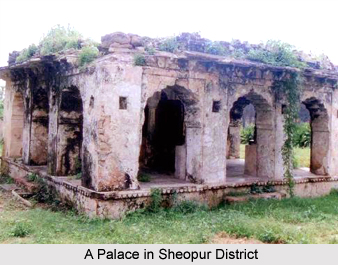
There are many tourist spots in district of Sheopur. These are as follows:
Doob Kund
In Sheopur district, there was a city in the Chambal River valley of Sheopur tehsil at some distance from river Kuno known as `Dom`. It was the capital of Kachwaha Kings. Here stands 81 feet high, large and square `Chaubisi of Jain Tirthankaras`, which is still worth seeing. The pillars remind the visitors of the art of Jainism. In the middle of the "Chaubisi", one could see a kund where the statues where sunk. Since than, it is called Doob Kund. Outside it, there are the remains of Har Gauri Temple that was built in 10th Century
Sangam of Rameshwar
Sangam of Rameshwar is situated in the semi-circle of rivers `Parvati River` and `Chambal River` is full of natural beauties. It is 959 feet high from seashore. A local fair is held here every year. It is an attraction for the tourists especially for the people of Rajasthan.
Vijaypur Durg
At the bank of river `Kunari`, there stands a fort known as `Majhola durg`. Vijay Singh, the King of Karoli, built it.
 Kuno Wild Life Sanctuary
Kuno Wild Life Sanctuary is one of the major tourist attraction sites in Sheopur. It is located between latitudes 25 degree 30 second to 25 degree 53 second North and longitudes 77 degree 07 second - 77 degree 26 second East latitudes. The sanctuary is situated in an isolated hill, sloping in all directions. All the faunal representatives of the dry deciduous forest of the Central India can be found in Kuno Wild Life Sanctuary are Panther, Royal Bengal Tiger, Chital, Sambhar, Black Deer, Chinkara, Bear, Blue bull, Jungle cat, Barking Deer, Monkey, Jackals, Hyena, Wild Boar, Fox, Indian Cobra and many other animals.
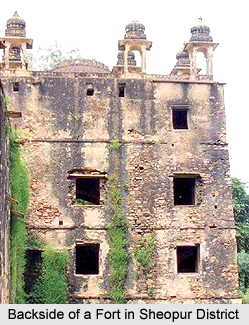
Other important places for tourists are the Fort of Sheopur, Dhuruvkund and Shivnath of Utanwad, The Muth of Nimoda, The temple of Devi Panwara, The temple of Shironi Hanuman, the water temple of Vadodora and the temple of Khhetrapal Jaini
The nearest airport to Sheopur is Gwalior State. This airport is well connected with Delhi, Bhopal, Indore and Mumbai. As with other light railways in the former princely state of Gwalior (now part of the Central Railway in Madhya Pradesh) this 200 kms 610mm-guage lines was originally sponsored by the Maharaja of Gwalior, reaching Sheopur in 1909. Sheopur is connected by regular bus services with Gwalior, Morena district, Sheopur and Kota district. Sheopur is 210 Kms. Away from Gwalior and 230 from Morena.