


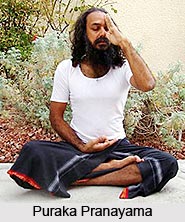
 Just like any Pranayamic or Ujjayi technique in general, the process of inhalation and exhalation is carried on a simultaneous basis and this particular technique is known as the "Puraka". It is a particular breathing technique and according to the yogi therapists it is a typical kind of single inhalation process. To be specific, in Puraka, one needs to keep one nostril close or the other, and in some cases, both the nostrils are closed down. There is a particular way of closing nostrils in the technique of Puraka. According to the views of many people, this way of closing the nostrils is not only very contented but it is also very much scientific. Just like any Pranayamic or Ujjayi technique in general, the process of inhalation and exhalation is carried on a simultaneous basis and this particular technique is known as the "Puraka". It is a particular breathing technique and according to the yogi therapists it is a typical kind of single inhalation process. To be specific, in Puraka, one needs to keep one nostril close or the other, and in some cases, both the nostrils are closed down. There is a particular way of closing nostrils in the technique of Puraka. According to the views of many people, this way of closing the nostrils is not only very contented but it is also very much scientific.
The right palm is generally stretched out; the index and the middle fingers are turned down, while the other two fingers and the thumb are extended a little bit. Now the thumb and the extended fingers are rightly placed on the bridge of the nose. Meanwhile one needs to place the thumb on the right side of it, and the fingers on the left side. Afterwards when the right nostril is being closed, the fingers are permitted to hang on to their position. Especially the thumb is being swoop downwards, and made it to remain stretched upon the flexible right nostril, pushing it against the 'septum' at the side and also the hard bone that is placed above it. Similarly, if one wants to close the left nostril, one follows the similar procedure, which he does with the right nostrils. However one can even perform the exercise in another way also. If both the nostrils are to be closed, both the thumb and the fingers are slided down, pressing against the nostrils, as has been done in both the two cases. Again, if both the nostrils are to be held open, there are two positions for the right hand that has been suggested. The fingers and the thumb can be kept on the bridge of the nose. If one wishes one can even place his right hand on the knees. As per as Puraka is concerned, Ujjayi Yogis discussed this exercise procedure much in details Every Puraka should begin after completing the task of expiration. In Ujjayi, breath is to be inhaled through both the nostrils. While exhalation, one needs to breathe in air from the chest. Further one needs to expand it and the air will smoothly drawn out. Throughout the inhalation, the vocal organ, glottis, is to be partially closed. This partial closure of the glottis will produce a continuous sound like the sound, which seems as if some one is weeping. The sound goes on for some time. At the time of breathing in, both the muscles of the face and also the nose muscles should not be compressed. This contraction of facial muscles is of no use in gulping air. Some people, however, have developed the habit of twisting the whole face, during inhalation, which should be absolutely avoided. Puraka technique, as adopted during Ujjayi exercise, extra care is to be taken for the abdominal muscles. They must be remained under proper control with a very little compression, and this should be maintained throughout the breathing in. There are certain phallacies associated with the Ujjayi exercise. However, there are certain scientific evidences, which demonstrated the fact that the compressed abdomen allows at a time more oxygen to be inhaled. |
| |||



Puraka
| Reckoned as a particular technique of Pranayama, Puraka is a "simultaneous breathing process". |
| ||||||||||||||||||||||||||||

