


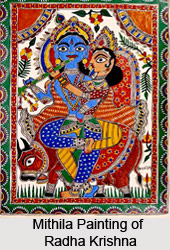
 India, a land so ancient, both in culture and history has always witnessed a diverse population, geography and climate. Right from the very beginning, it has been a treasure of rich art and architecture, which replicate an eye for detail, a love for color and form the inherently artistic individuality of the people of India. India, a land so ancient, both in culture and history has always witnessed a diverse population, geography and climate. Right from the very beginning, it has been a treasure of rich art and architecture, which replicate an eye for detail, a love for color and form the inherently artistic individuality of the people of India.
History of Mithila Painting Mithila Painting is one famous and very distinct style of Indian art commonly known as Madhubani painting, discovered by William Archer, a local Collector of a small province in 1934. Precisely, from the age old times, there has been an amalgamation of foreign and native influence that has shaped the course of Indian art. Indian artists and their paintings are world famous. There is simply no comparison. Women of the Mithila region of northern Bihar used to do wall and floor paintings for centuries on certain occasions of marriage and other domestic ceremony. The images, although used to be similar, but individual style of canvas were developed by women of different castes. This painting is an articulation of peoples' compassion and understanding for life and culture. During the Ramayana age, king Janakpuri had assigned the task to few artists of painting, sketches of Sita's marriage to Lord Rama. This was the origin of the famous art style of Madhubani paintings. These paintings are cloaked in archeological discovery of the Indian history of the place Mithila from where its name originated. As stated earlier, this style of painting had been a part of Indian art for ages, although hardly anyone was aware of it. It came into spotlight when once, William Archer had gone for inspection to the villages of Mithila, after a major earthquake, found these beautiful work of art developed on almost all the walls and floors of the village, liked them so much that he photographed them. He was so impressed with the artwork and the detail involved in each of the art piece, that he and his wife brought them to the modern lime light via some publications. 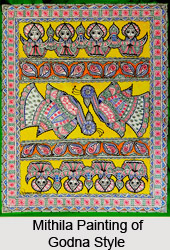 After that 1950s-60s several Indian researcher and intellectuals visited these villages and became captivated with the art. It is then, the mass came to know that such a distinct style of painting existed in a small region of India. However, only by 1966 this art of painting was encouraged.
Features of Mithila Painting An art is popular; only when it can express the sensitivity of people by building up an artistic expression and as well imitate the customs and moral values and reveal the society's psychology from where it is emerging. This reason is self sufficient to justify the fame of the Mithila paintings. Themes of Mithila Painting These paintings are a living language. It has its own unique grammar, rules, meaningful icons, motifs and images. They are like a mirror, which reflects the values and morals of the society. It has a vernacular flavor and if observed carefully, one will always find the psychology and belief prevailing in the society. This painting deals with significant and expressive images in its own ways. Over time, aside from the growing diversity of painting, the subject matter of the paintings has expanded to include ancient epics, domestic, rural, and community life ritual, local legends and tales, local, national, and international politics, as well as the painters' own life histories. Artists of different castes and genders are now borrowing themes and styles from one another. Mithila painting has established extraordinary vitality and become an effervescent and aesthetically powerful tradition. Mithila painting, for centuries, was addressed to Gods and Goddesses of the Hindu religion, with interwoven component of family's interwoven activities of daily life and the ritual and spiritual life. Mithila painting must have changed and evolved during the centuries, although how the paintings changed between 14th and 20th centuries is not known. They still today dish up the same daily, religious and ritual purposes but the world of painters operating and their understandings, concerns and engagement has developed by many folds. Styles of Mithila Painting Madhubani art has five distinctive styles namely Bharni, Kachni, Tantrik, Godna and Kohbar. In the 1960s Bharni, Kachni and Tantrik styles were mainly done by Brahman and Kayashth women, who are 'upper caste' women in India and Nepal. Their themes were mainly religious and they depicted Gods and Goddesses paintings. People of lower castes included aspects of their daily life and symbols, the story of Raja Shailesh [guard of the village] and much more, in their paintings. Nowadays Madhubani art has become a globalised art form, so there is no difference in the work on the basis of the caste system. They work in all five styles. Madhubani art has received worldwide attention. Elements of Mithila Painting The styles of Mithila painting have been traditionally done by the women of the village around both the villages of Mithila and Madhubani. In primeval times these art work was done only on freshly plastered mud houses but these days it has acquired its position almost on anything starting from glass to cloth, and canvas to paper etc. 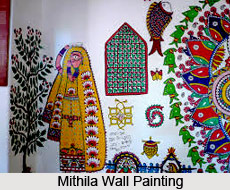
The colors used to paint this style of art, were homemade natural colors in the beginning. They were extracted from the flowers and plants available like bougainvillea, neem, henna leaves etc. and the juice of the leaves and flowers obtained were mixed with resin and ordinary gum so that the paint could stick to the painting medium. But now colors come in powdered form although black is obtained from the filth deposits by the diya flame and then dissolved in gum. Famous Paintings from Mithila Painting This form of art was best used in depicting mythological and natural events including Hindu Gods and Goddesses including Rama, Shiva, Brahma, Durga etc. They even painted natural objects like sun, moon or other auspicious and religious objects. Usually all empty spaces in the painting were filled with paintings of geometric shapes, flowers, animals etc. Famous Painters and Achievements of Mithila Painting Madhubani painting received official recognition in 1969 when Sita Devi received the State award by Government of Bihar. Jagdamba Devi was the first artist from Mithila to receive a National Award in Mithila paintings. In 1975, the President of India gave the Padma Shri award to Jagdamba Devi, and the National Award to Sita Devi of Jitwarpur village near Madhubani. Jagdamba Devi's foster son Satya Narayan Lal Karn and his wife Moti Karn are also well-regarded Mithila artists, and they won the National Award jointly in 2003. Sita Devi received the Padma Shri in 1981. Sita Devi was also awarded by Bihar Ratna in 1984 and Shilp Guru in 2006. In 1984 Ganga Devi was awarded by Padma Shri. Mahasundari Devi received the Padma Shri in 2011. Baua Devi, Yamuna Devi, Shanti Devi, Chano Devi, Bindeshwari Devi, Chandrakala Devi, Shashi kala Devi, Leela Devi, Godavari Dutta, and Bharti Dayal were also given the National award. Chandrabhushan (Rasidpur), Ambika Devi (Rasidpur), Manisha jha were also given the National award. In 2020, Madhubani artist Dulari Devi won the Padma Shri for contributions to art. Over the years the tradition has been inherited maintaining the same style and form. This style of painting could even be used to find 3-D imageries. Clearly visible and still alive, these paintings are a breathing expressive mode of communication. |
| |||



Mithila Paintings
| Women of the Mithila region of northern Bihar, used to do wall and floor paintings, known as Mithila painting. One famous and very distinct style of Indian art is Mithila Painting or as commonly known, Madhubani painting, discovered by William Archer, a local Collector of a small province in 1934. |
| ||||||||||||||||||||||||||||

