


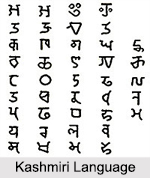
 Kashmiri Language is spoken in the Valley of Kashmir and the neighbouring hills. Amongst the various languages of Indo - Aryan languages, Kashmiri languages are a famous language belonging to the north-western group. Mostly the residents of Jammu and Kashmir valley speak Kashmiri. It has about 7 million speakers. Kashmiri vocabulary is mixed, containing Dardic, Sanskrit, Punjabi, and Persian factors. Religious differences are evident in vocabulary and choice of alphabet. Kashmiri Language is spoken in the Valley of Kashmir and the neighbouring hills. Amongst the various languages of Indo - Aryan languages, Kashmiri languages are a famous language belonging to the north-western group. Mostly the residents of Jammu and Kashmir valley speak Kashmiri. It has about 7 million speakers. Kashmiri vocabulary is mixed, containing Dardic, Sanskrit, Punjabi, and Persian factors. Religious differences are evident in vocabulary and choice of alphabet.
History of Kashmiri Language Kashmiri is part of the Indo-Aryan group of the Indo-European language family. More often it is sometimes placed in a geographical sub group, known as Dardic. Among twenty-three 'scheduled languages' of India, Kashmiri is a significant one. It has a rich heritage. In the year 1919, George Abraham Grierson commented Kashmiri is the only one of the Dardic languages that has a literature. In fact Kashmiri literature too has originated at a time, which is more than 750 years ago; it reveals the antiquity of Kashmiri language, which falls in the genre of Modern literature. The most primitive literary masterpiece in Kashmiri that has survived is the poetry of Lalleshvari, a fourteenth century spiritual poetess. 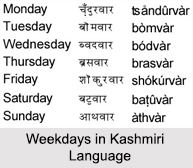 Kashmiri first appeared in writing during the 8th century AD in the Sharda alphabet, which is still used in religious ceremonies by Kashmiri Pandits. After the entrance of Islam in Kashmir during the 15th century, the Arabic script was adapted to write Kashmiri. Today Kashmiri Muslims write their language with the Arabic script, and Kashmiri Hindus used the Devanagari alphabet. Kashmiri first appeared in writing during the 8th century AD in the Sharda alphabet, which is still used in religious ceremonies by Kashmiri Pandits. After the entrance of Islam in Kashmir during the 15th century, the Arabic script was adapted to write Kashmiri. Today Kashmiri Muslims write their language with the Arabic script, and Kashmiri Hindus used the Devanagari alphabet.
Grammar and Vocabulary of Kashmiri Language There are four cases in Kashmiri Language: ‘nominative’, ‘genitive’, and two ‘oblique’ cases: the ergative and the dative case. There are two genders in Kashmiri Language - masculine and feminine, and nouns are inflected based on gender and word endings. Kashmiri Language has thousands of loan words (mainly from Persian and Arabic) due to the arrival of Islam in the Valley; it remains basically an Indo-Aryan language close to Rigvedic Sanskrit. There is a minor difference between the Kashmiri spoken by a Hindu and a Muslim. Certain words in Kashmiri even appear to branch from Indo-Aryan even predating the Vedic period. Writing System of Kashmiri Language There are three orthographical systems which are used to write the Kashmiri language and these are the Sharada script, the Devanagari script and the Perso-Arabic script. The Kashmiri language is traditionally written in the Sharada script after the 8th Century A.D. Today it is written in Perso-Arabic and Devanagari scripts (with some modifications). Among languages written in the Perso-Arabic script, Kashmiri is one of the very few which frequently shows all vowel sounds. The Kashmiri Perso-Arabic script has come to be related with Kashmiri Muslims, while the Kashmiri Devanagari script has come to be associated with the Kashmiri Hindu community. Standard Kashmiri dialects include Kishtwari, Kashtawari, Kistwali, Kashtwari, Kathiawari . There are also other dialects that have been originated from Kashmiri, all influenced by 'Dogri'. These are namely Miraski, Poguli, Rambani, Riasi, Shah-Mansuri, Siraji of Doda, Siraji-Kashmiri, Zayoli, Zirak-Boli, Bunjwali, and Bakawali. |
| |||



Kashmiri Language
| Kashmiri or Koshur, is a language from the Dardic subgroup of the Indo-Aryan languages and it is spoken chiefly in the Kashmir Valley and Chenab valley of Jammu and Kashmir. |
| ||||||||||||||||||||||||||||

