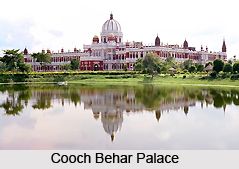
 Tourism in Cooch Behar covers various historical monuments, religious places and a number natural setting. Cooch Behar is one of the most isolated areas of India, which is located by the side of the Brahmaputra River in the narrow neck of land which connects the main body of the country to the Indian state of Assam. It is surrounded by a tangle of international boundaries like Nepal, Sikkim, Bhutan and Bangladesh all lie nearby, but it is rarely visited by tourists. The dynasty arose from the Koch tribe, who established para-mountcy in the 16th century. Later the state acted as a buffer between Bengal and the tribal kingdoms of Assam. In the year 1863, the British reorganized state administration and trained a series of model rulers, as a result of which the state became an exemplar of social progression. This is expressed in the principal buildings and institutions, which are disposed around the main square; two schools, a court house, a jail, a state archive and printing office.
The New Palace is built in an Italian renaissance style with arcaded inner courtyards and a large central dome modelled on St Peter`s, Rome. It is by a Western architect and is a creditable composition, if somewhat lacking in cohesion. The Durbar Hall has decorations in the manner of Raphael. The principal rooms are also European in conception, with Chippendale-style mirrors, painted and gilded ceilings, and elaborate French furnishings.
Pilgrimage Tourism in Cooch Behar:
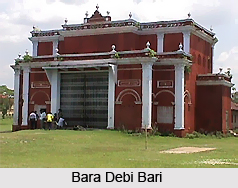
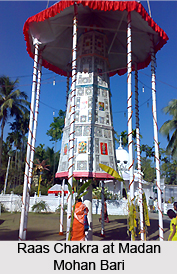
The Madan Mohan temple in Cooch Behar is located in the center of the town. It was constructed in the year 1885, and has the deities of Lord Madan Mohan, Ma Tara, Kali and Bhavani. During the famous Raas Puja the conventional Yatra Festival and the Fair or Mela is held. It is the biggest festivals of North Bengal. Some of the other renowned temples in this city are Bara Debi Bari and Rajmata Temple. The temples of this place provide a special importance to the grandeur of the land. Madan Mohan temple is constructed by Raja Nripendra Narayan in the year 1885. Its principal attraction is the influence of the European sculpture in the structure of the temple. The Roman poque architecture is the speciality of the Brahmo Temples here, which bears the quintessence of the Brahmo influence in the Maharaja of Cooch Behar. Though the original one was destroyed, Kamteswari Temple, constructed in the year 1665, by Maharaja Pran Narayan, is the reminiscent of the Koch dynasty here. The other notable temples here are Siddhanath Siva Temple, Madhupurdham Temple and Siddheswari Kalibari etc. The temples of the region collectively forms the `heritage land` in Cooch Behar, which not only attract a bulk of tourist but are themselves, of immense importance as they are the concrete representation of the history of the region. The primitive Baneswar Temple, situated on the way to Alipurduar, is known for its rare giant turtles, which are protected with suitable assistance from the people of the locality as part of their religious faith.
 Nature Tourism in Cooch Behar:
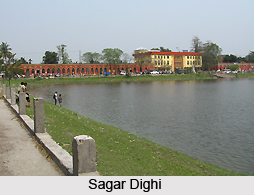
SagarDighi is one of the most prominent water body situated in the town. It is located in the central part of Cooch Bihar. The SagarDighi is surrounded by the very old royal heritage buildings on four sides of the square shaped lake. The lake is also known for the feathered animals. One can enjoy the beauty of a large number of migratory birds which assemble in the lake every year. Among the major species lesser whistling teal, cotton teal, ruddy shell duck are worth mentioning. The right time to watch birds in SagarDighi is from the month of December to February. Covering an area of about two thousand and five hundred hectares on the road from Alipurduar to Khamakhyaguri, the biggest place for migratory birds in North Bengal is situated which is called RasikBill. Situated close to it is a well-furnished resort.
Regarding those sanctuaries mention may be made of the Buxa Tiger Reserve. It is a picturesque reserve with its phenomenal Terai & Bhabar and hilly landscape and offers a veritable flora & fauna, which attract visitor on a large scale. The generic diversity of mammals in the Buxa reserve forest is the second highest among all the tiger reserves in India. Though the Bengal Tiger is the key attraction here, there are several leopards, fishing cat, Indian Civet, Palm Civet, Wild dogs, which attract the tourists to a large extent. The Avifauna is rich in both endemic & migratory species. The Trans Himalayan migratory species like Goosanders, the Ibis bill, resident fork tails, and varieties of Red-stars, Wagtails, the Teals (Common teals, whistling teal etc.), White eyed Poachard, hornbills etc. abound the area. Buxa is also an important site for the adventurous tourists who love trekking because many trek routes originate from Buxa.
Jayantia cast a charming environment, where the chief attraction is the huge stalactite cave commonly known as the Mahakal Cave. Another precious adventure of Jayantia is the narrow, damp and dense forest. Rajabhatkhwa, encircled by the dense forest of the Buxa Tiger Reserve, is an ideal place for those loving forests & wild life. In the deep inside there are the opportunity to view elephant, bison & even tiger. From October to April plentiful of travelers visit the Reserves & Sanctuaries. Cooch Behar is mainly a tourist spot and there are ample reasons behind the growth of tourism in the district. The part of economy, which is undersupplied by the agriculture & industry, is supported by the tourism.
Leisure Tourism in Cooch Behar:
 The notable tourist attraction in Cooch Behar is the Palace or Rajbari. It is considered to be the pride of the city. In the year 1887, the renowned Koch King, Maharaja Nripendra Narayan constructed this renowned palace. The construction of this palace was molded on the classical European style at the time of Italian Renaissance. The magnificent double storied building made of brick spreads over an area of 4768 square meters. It stretches one hundred and twenty meters from the north to south and ninety meters from the east to west.
The Palace architecture is worth mentioning. There is a conclave shaped porch which is designed in the central parts of the main entrance of the building going through the Durbar Hall. This Durbar Hall is in the shape of a dodecagonal, standing on four arches having the support of monumental Corinthian pilasters and casting a lantern at the top. It recalls the St. Peter`s Church at Rome. The building possesses fifty or more massive halls, which bears the bedrooms, billiard room, dressing rooms, kitchen, dancing hall, dinning hall, library and the ladies gallery. The rooms are known for their striking Royal paintings which decorates the ceiling and the interior wall.
The Raas Mela is considered to be one of the most primitive and traditional of all fairs. Each and every year, when the festive mood of the departed festival of Durga Puja still hovers in the minds of people, the people of Cooch Behar become ready to celebrate the Raas Yatra of Sri Sri Madan Mohan Thakur. The celebrations start from the divine day of Purnima in the Kartik month of Bengali calendar. The festival of Ratha Yatra is celebrated in the month of Asardh as per the Bengali calendar in Cooch Behar. Sri Sri Madan Mohan rides on the well-decorated Rath from main temple and goes to the house of his maternal aunt at Gunjabari, where he stays for one week. On the Ulta-Rath celebrations, the idol of Sri Sri Madan Mohan is brought back to the main temple.
The festival of Muharram is celebrated with much enthusiasm in Cooch Behar and in this occasion, in the Dinhata town, a fair is organized after the rotation of Tajiyas round the town. The major attraction of the fair is `Lathi khela` or the game involving sticks. The Cooch Behar museum is situated inside the Cooch Behar Palace which contains a list of articles and photographs used by the maharajas and costumes, weapons and jewellery which were used by the North Bengal tribes.
 Visiting Information on Cooch Behar:
How To Reach Cooch Behar
By Road: There are rickshaws is Cooch Behar which form the major public transport of the town.
By Rail: The New Cooch Behar Railway Station is located at a distance of five kilometers from town and is suitably linked with a majority of cities in India. There is another Railway station named Cooch Behar which is situated inside the town, but two pairs of local trains only run on this route.
By Air: The nearest airport is at Bagdogra, close to Siliguri, which is situated at a distance of about about one hundred and sixty kilometres from Cooch Behar. The best time to visit this place is through out the year.
Cooch Behar has also acquired significance from the perspective of an archeological point of view since the excavation of remains at Gosanimari Rajpat where primitive stone engravings, stone sculptures and a water system were unearthed. Not only for the temples and palaces, Cooch Behar is also known for its sanctuaries and national parks. A large variety of wild life is the prominent attraction of the sanctuaries and the wildlife lovers and general tourists form the major portion of crowd in Cooch Behar.