


 Spreading over an approximate area of 518 sq. km, the Bori Wildlife Sanctuary is located in the Hoshangabad district of the state of Madhya Pradesh. It was established in the year 1977 and includes India’s oldest forest reserve, the Bori Reserve Forest, which was established in the year 1865 along the Tewa River. The Bori Wildlife Sanctuary is bounded by the Satpura National Park to the north and by the Tewa River to the west. This wildlife sanctuary, together with the Satpura National Park and the Panchmarhi Sanctuary forms the Panchmarhi Biosphere Reserve. Spreading over an approximate area of 518 sq. km, the Bori Wildlife Sanctuary is located in the Hoshangabad district of the state of Madhya Pradesh. It was established in the year 1977 and includes India’s oldest forest reserve, the Bori Reserve Forest, which was established in the year 1865 along the Tewa River. The Bori Wildlife Sanctuary is bounded by the Satpura National Park to the north and by the Tewa River to the west. This wildlife sanctuary, together with the Satpura National Park and the Panchmarhi Sanctuary forms the Panchmarhi Biosphere Reserve.
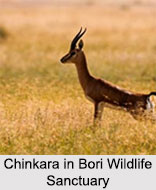
Climate of Bori Wildlife Sanctuary During the summer months, the average temperature of the wildlife sanctuary ranges from a maximum of 35° C to a minimum of 19° C between the months of March to June. During the winter months of November to February, the temperature ranges between a maximum of 22° C to a minimum of 8° C. The Bori Wildlife Sanctuary receives an average rainfall of 1,750 mm and the maximum amount of rainfall is received between the months of July and August. There are certain projections of the Satpura Ranges such as the Sakott Hill and the Gottu Deo Hills, which invade the area of this sanctuary. The forest floor, which slopes up and down principally, consists of fertile black cotton soil, mixed with sandy loam. However, in the hills, the soil is primarily made up of sandstones, shale and basaltic rocks. Flora and Fauna of Bori Wildlife Sanctuary The Bori Wildlife Sanctuary is mostly covered in mixed dry tropical deciduous and bamboo forests, along-with part of the Eastern Highlands moist deciduous forests eco-region. The dominant tree species here are teak, axel wood, bael, kadam, rosewood tree, temburini, java plum, etc. There is over 1,300 species of plants here including Sal, bamboo, a number of medicinal plants and rare mosses along-with some water ferns species. 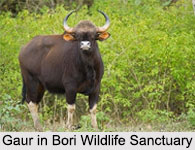 The Bori Wildlife Sanctuary houses a large number of mammal species including tiger, leopard, wild boar, muntjac deer, gaur, striped hyena, chital deer, sambar, chinkara, rhesus macaque, nilgai, four-horned antelope and many others. The Bori Wildlife Sanctuary houses a large number of mammal species including tiger, leopard, wild boar, muntjac deer, gaur, striped hyena, chital deer, sambar, chinkara, rhesus macaque, nilgai, four-horned antelope and many others.
The main attraction of the Bori Wildlife Sanctuary is the tiger. The sanctuary draws a large number of tourists mainly during the months of October to June, which is the ideal time to visit. Since the sanctuary has become a prominent tourist spot, there are many forest bungalows and guesthouses, which serve as lodging for the tourists. The variety of safaris and the nature walks enable the tourists to experience the natural beauty of the jungle to its full extent. Visiting Information on Bori Wildlife Sanctuary The closest airport to the Bori Wildlife Sanctuary is the Raja Bhoj airport in Bhopal, which is at a distance of about 200 km from Panchmarhi. The Pipariya Railway Station is the nearest at a fair distance of 152 km from this wildlife sanctuary. |
| |||



Bori Wildlife Sanctuary
| Located on the northern foothills of the Satpura Ranges, the Bori Wildlife Sanctuary is an important transition zone between the forests of western and eastern India. |
| ||||||||||||||||||||||||||||

