Bead making
|
Bead making is the most ancient art form and is one of the popular crafts in Indian subcontinent.
|
|
|
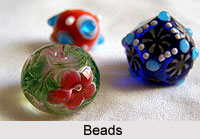 Bead making is the most ancient art form and a popular craft in Indian subcontinent quite unique involving expertise and creativity. The process of bead making first came forth at almost three thousand years ago. The glass bead making involves manipulation of glasses and is segregated into three main categories. These include moulded beads, wound beads and drawn beads. There are many forms of metamorphosing molten glass in bead the most popular one being lamp- winding. Bead making is the most ancient art form and a popular craft in Indian subcontinent quite unique involving expertise and creativity. The process of bead making first came forth at almost three thousand years ago. The glass bead making involves manipulation of glasses and is segregated into three main categories. These include moulded beads, wound beads and drawn beads. There are many forms of metamorphosing molten glass in bead the most popular one being lamp- winding.
The work of glass bead making started as a creative writing practice. In the first place, the bead makers or the artisans produced varied decorated beads in 'latticini, stripes, ribs and dots' the technique being so easy and simple that one can try their hands in making beads at individual homes also. Although the art of glass bead making is simple it involves a lot of concentration and skill. However for a beginner it is better to know the nitty-gritty's of the work where one needs to know some basic knowledge on glass basics, equipments arrangement, safety and tools.
Only a torch will have to be used for melting the glass beads. Afterwards a metal mandrel rod has to be dipped into 'mandrel coating' and has to leave as it is through out the whole night for drying out.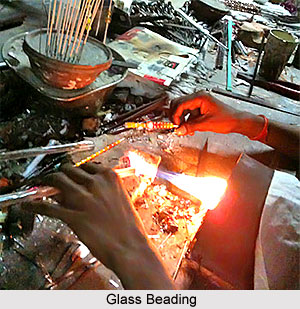 Before starting the work one has to wear their safety glasses and then the torch to be concentrated upon it. It does not stop here only; a lot more works are associated with it. After finishing bead making, there is a huge task left to design the beads. Various decorating processes are followed like, raking, dots, drags and also decorating them with flowers etc. Before starting the work one has to wear their safety glasses and then the torch to be concentrated upon it. It does not stop here only; a lot more works are associated with it. After finishing bead making, there is a huge task left to design the beads. Various decorating processes are followed like, raking, dots, drags and also decorating them with flowers etc.
Glass bead making in India is very popular in fact India being the fountainhead of bead making. Three large bead industries have developed along with proliferation of few hundreds of small bead making industries.
The art of Bead Making is again not a new concept to the Indians. Shell working and steatite bead making was always there as quite an integral part of Indian art even in the remote past of the ancient rimes of the Indus Valley Civilisation. The art, which was then rather unorganized, later gained a modern facet with the introduction of latest technology. Even in the modern era, the rural areas of Gujarat, Bihar and some part of the North India still carry the aura of this archaic art form amidst their artistic expression.
|
|
|
|





